
Small Tile Adhesive Making Machine Solutions
1–10 T/H Tile Adhesive Making Machines for Small and Medium Production
FUREIN supplies 1–10 T/H tile adhesive making machines for startups, small mortar factories and customers who need a compact and flexible production solution.
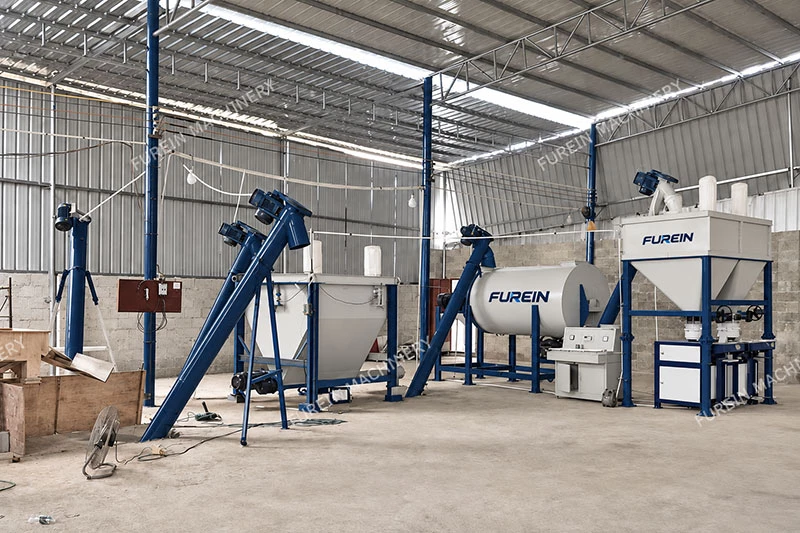
The layout of the small tile adhesive production line can be adjusted according to the available workshop height and floor space. Selon le projet, the weighing system can be installed below the mixer, in front of the mixer, or integrated into the feeding section.
The packing system can also be selected according to the customer’s bag type and required output. Open-mouth bags, valve bags and small-dose packing can all be supported with suitable packing equipment.
The goal is simple: use the space you already have, choose only the equipment you really need, and build a practical tile adhesive production system without unnecessary investment.
Capacité environ 10t/h
Two Capacity Options for Standard Tile Adhesive Making Machine
Choose the output that matches your current market and future production plan.
How to Choose the Right Tile Adhesive Making Machine?
The right small tile adhesive production line should be selected according to your raw materials, factory space, capacité requise, bag type and preferred level of automation. For small projects, the most important point is not to use the most equipment, but to make the whole process simple, practical and easy to operate.
Choose the Feeding Method
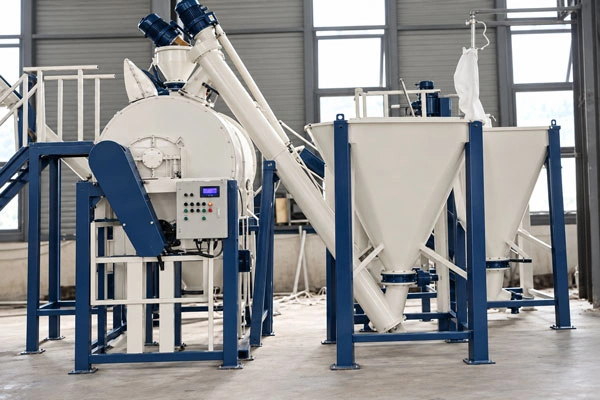
Different raw materials may require different feeding methods. Powder materials can be transferred by screw conveyor, while sand or bulk materials can also be fed by bucket elevator or hopper according to the plant layout.
Choose the Weighing Position
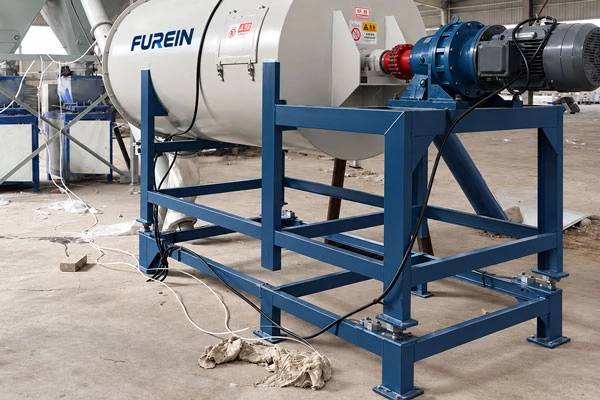
The weighing system does not have to be installed in only one position. Depending on the workshop height and equipment arrangement, the weighing hopper can be placed below the mixer, in front of the mixer, or above the mixer together with the feeding system.
Choose the Mixer
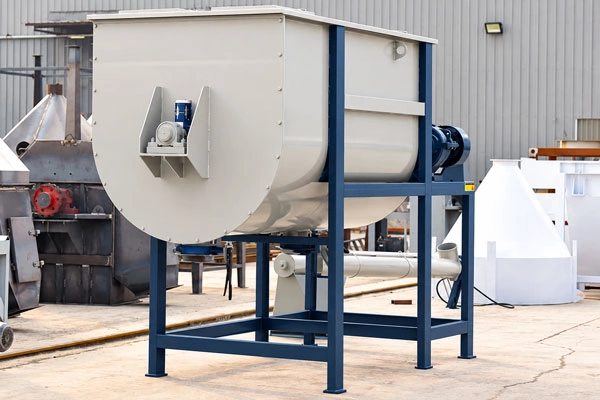
Small-capacity projects can use a ribbon mixer for a simple and economical configuration. For higher output or faster mixing, a double-shaft paddle mixer can be selected.
Choose the Packing Method
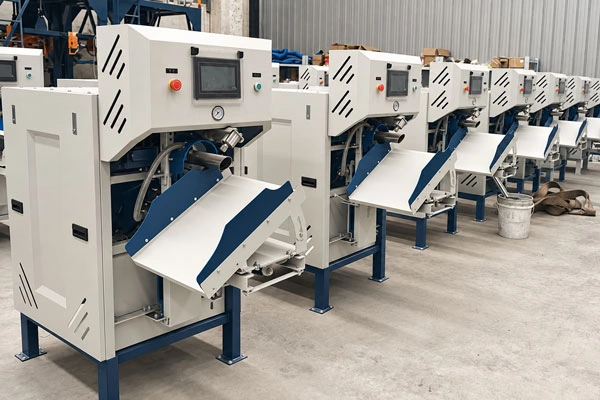
The packing machine should match the bag type, powder characteristics and required packing speed. Sacs à valves, open-mouth bags and smaller packing sizes can all be supported with different packing equipment.
Packing Options for Small Tile Adhesive Production Lines
Different customers use different bags and packing sizes. FUREIN can match the tile adhesive packing machine to your bag type, powder characteristics and required output.
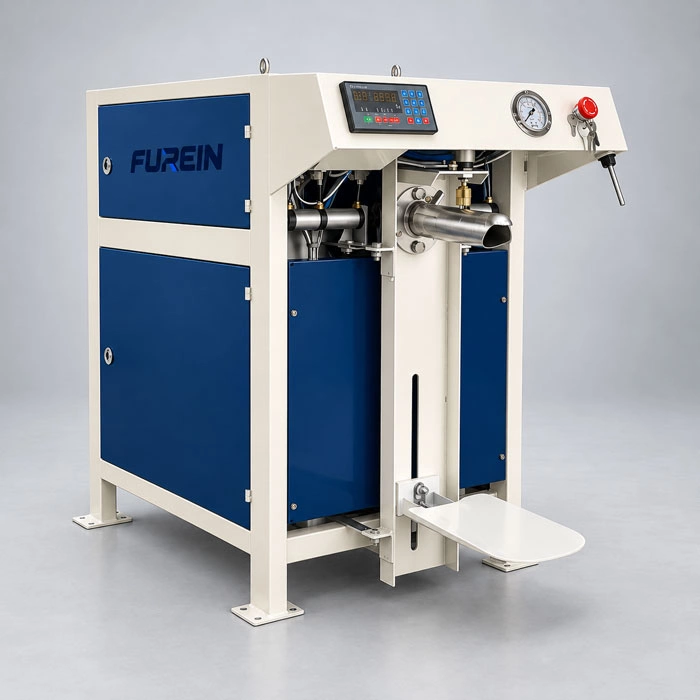
Machine à emballer de sac de valve
Commonly used for tile adhesive and other dry mortar products. Valve bags are easy to fill and do not require separate sewing after filling.
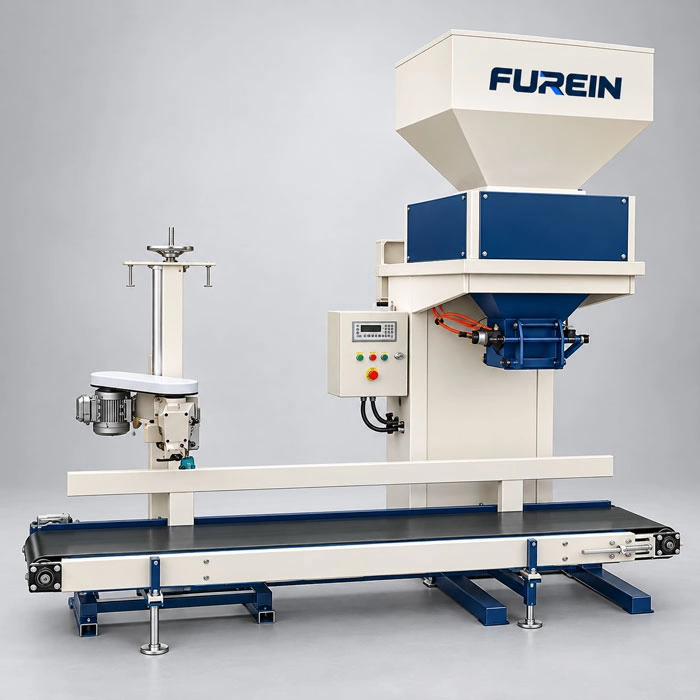
Open-Mouth Bag Packing Machine
Suitable for open-mouth bags and customers who need flexible bag sizes. The bag is placed manually and can be sealed by sewing or heat sealing depending on the bag material.
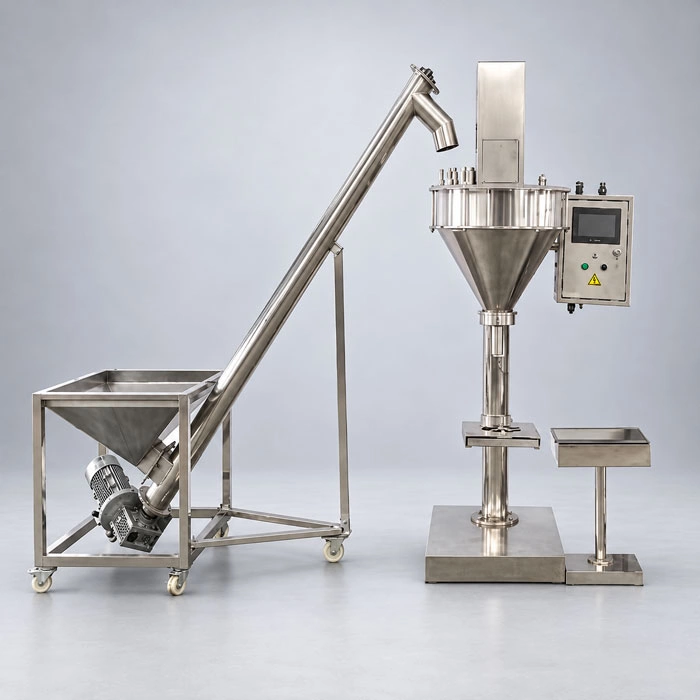
Small-Dose Packing Machine
Suitable for smaller bags or products that need lower packing weights. The configuration can be adjusted according to the required bag size and weighing range.
Small Footprint & Easy Installation
One of the main advantages of a small tile adhesive making machine is that it can be installed in a relatively compact workshop.
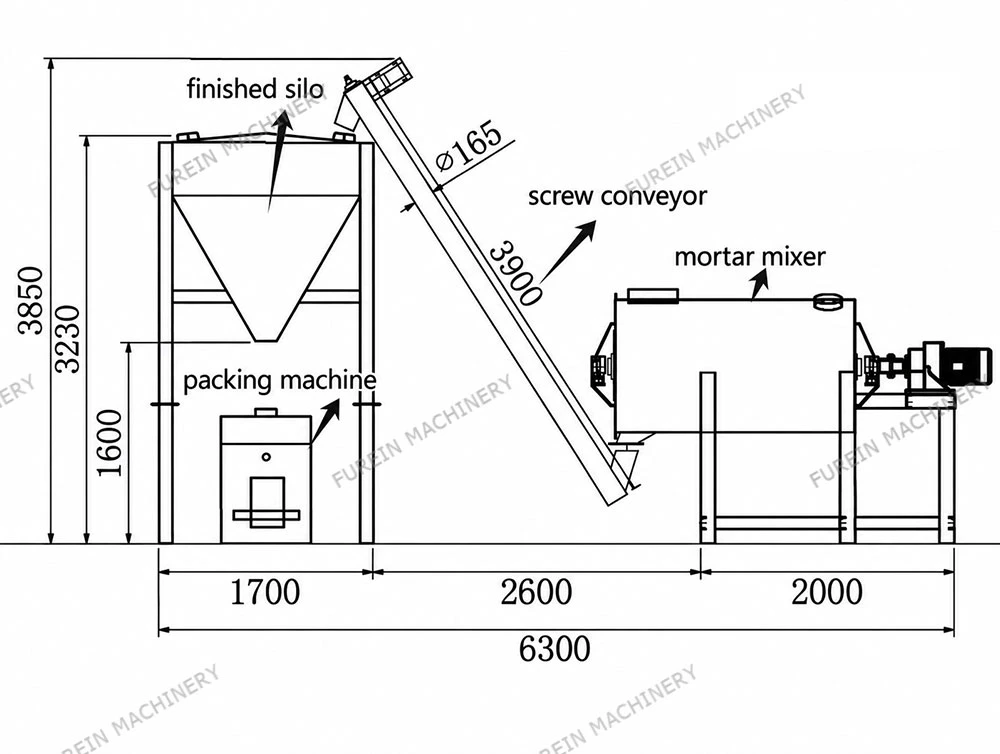
The equipment layout can be adjusted according to the available floor space and building height. For customers with an existing workshop, we can prepare a layout drawing based on the actual dimensions before production starts.
Compared with a large automatic mortar plant, a compact tile adhesive line requires less steel structure, fewer silos and a simpler installation process. This can reduce both installation time and initial investment.
Do You Need a Sand Dryer for a Small Tile Adhesive Production Line?
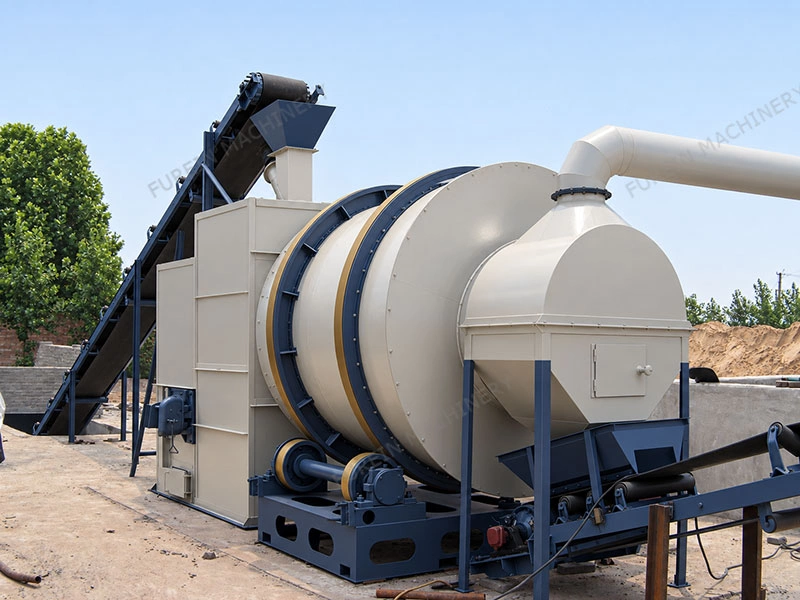
If you purchase dry graded sand, a sand dryer is normally not required.
If the sand moisture is higher than about 1%, drying may be recommended before the sand enters the tile adhesive production process. Excess moisture can affect weighing accuracy, material flow and final product stability.
For a small tile adhesive production line, the commonly selected sand dryer capacity is around 3 T/H or 5 E, depending on the sand moisture and required production output.
The dryer capacity should be selected according to the wet sand moisture rather than only matching the mixer capacity.
Real Layout Examples for Small Tile Adhesive Making Machines
Small tile adhesive projects often look different because customers have different workshops, raw materials and packaging methods. These project examples show how the equipment can be adjusted to different production conditions.
Many customers already have an existing workshop, limited building height or a preferred feeding method. Instead of forcing every project into the same standard layout, FUREIN adjusts the small tile adhesive machine design according to the actual site.
Based on previous projects, we have added wear-resistant liners under mixers, installed batching hoppers above mixers, changed weighing positions, adjusted feeding directions and modified packing layouts to suit different factory conditions.
3–5 T/H Tile Adhesive Line with Bottom Weighing System
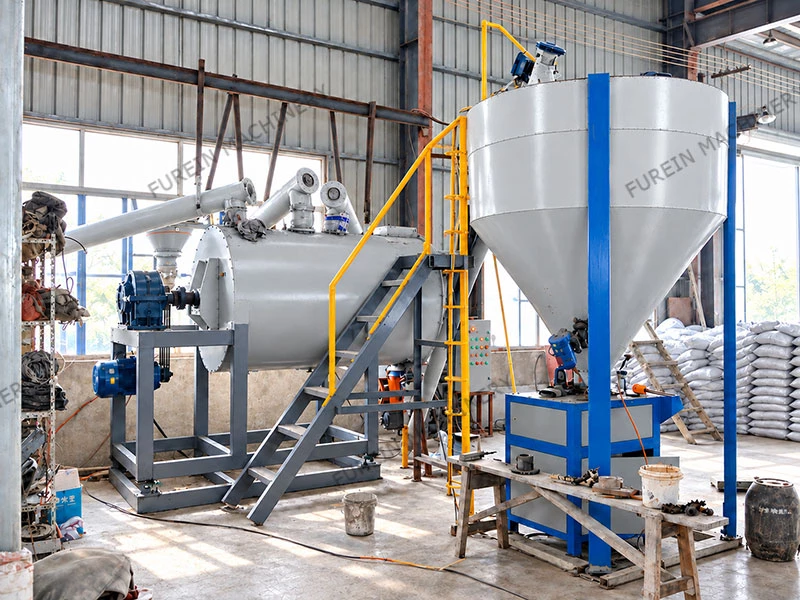
Fonctionnalité: Automatic Batch Weighing Under the Mixer
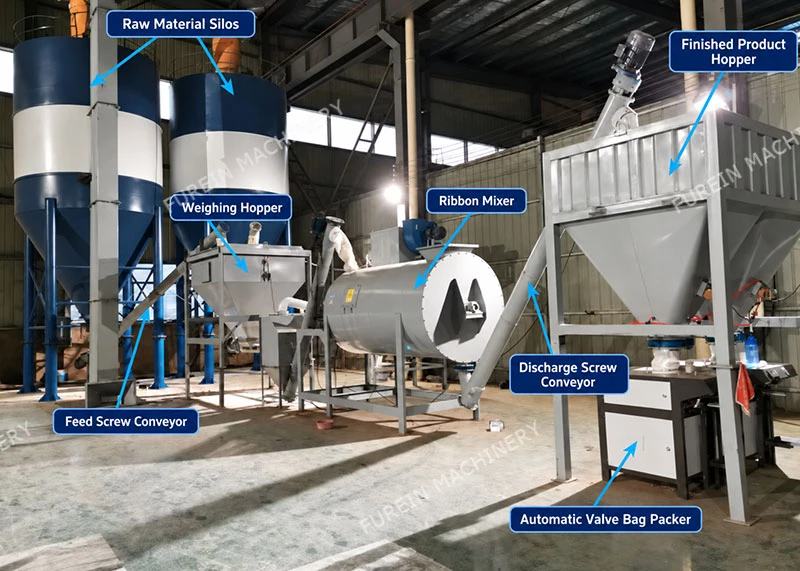
This 3–5 T/H small tile adhesive production line uses an outdoor cement silo and screw conveyor to feed cement directly into an O-type ribbon mixer. A weighing system is installed below the mixer to automatically weigh each batch. The required recipe can be preset in the control cabinet, helping improve batch consistency while keeping the overall layout compact.
5–6 T/H Tile Adhesive Line with Three Feeding Systems
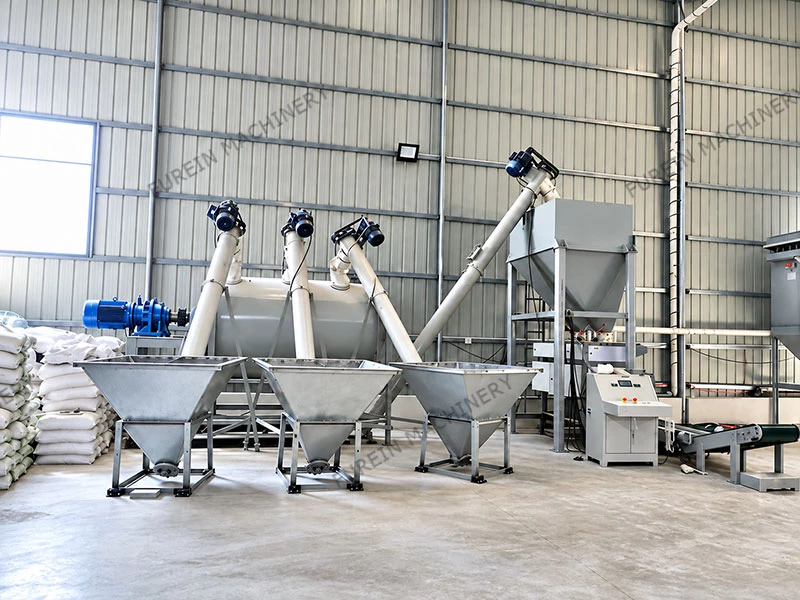
Fonctionnalité: Three Feeding Lines for Main Raw Materials
This 5–6 T/H tile adhesive making machine uses three separate feeding systems to transfer the main raw materials into the mixer. Après avoir mélangé, the finished material is discharged from the bottom of the mixer and transferred by a second screw conveyor to the finished product hopper for packing. This layout is suitable for customers who need to handle several main raw materials in a simple and organized way.
6–8 T/H Tile Adhesive Line with Buffer Hopper
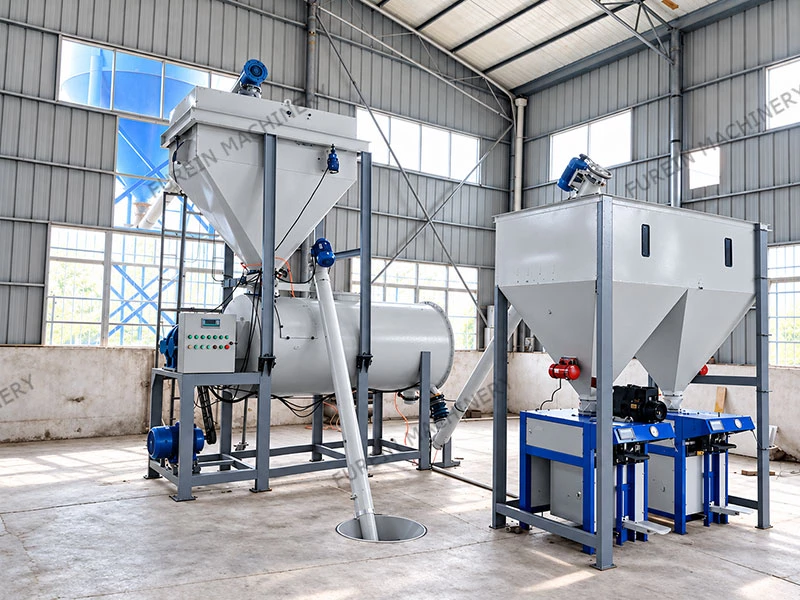
Fonctionnalité: Buffer Storage Above the Mixer for Faster Feeding
This 6–8 T/H small tile adhesive production line is designed to improve feeding speed. A buffer hopper is installed above the mixer to temporarily store cement and other main materials. Smaller materials can be lifted from ground level by screw conveyor and fed into the system. Two valve bag packing machines are used to improve packing efficiency and better match the mixer output.
Twin-Mixer Tile Adhesive Production Line
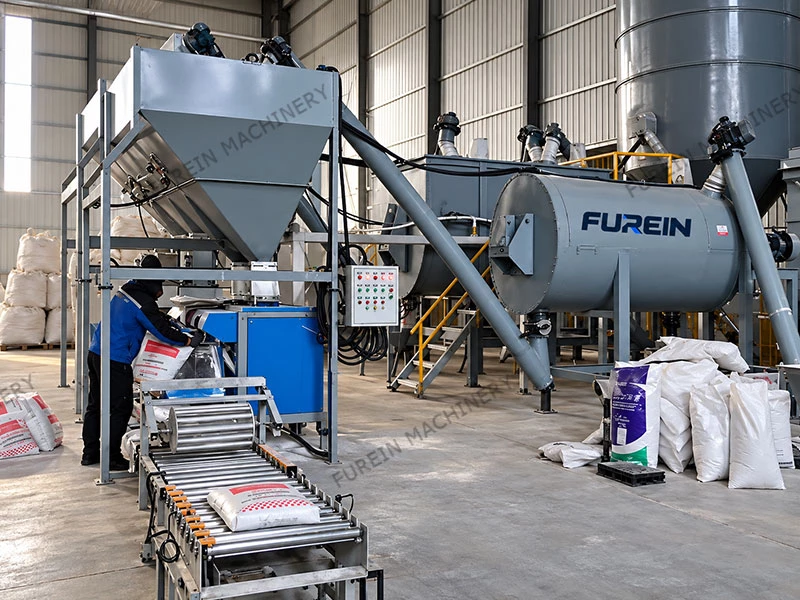
Fonctionnalité: O-Type and U-Type Ribbon Mixers in One Production Site
This tile adhesive production site uses two mixers: an O-type ribbon mixer and a U-type ribbon mixer. The U-type mixer provides a more stable structure for certain raw material combinations and can be selected when the production formula contains more material types. The complete line is equipped with four air packing machines to handle higher packing demand and support continuous production.
Fully Automated Small Tile Adhesive Production Line
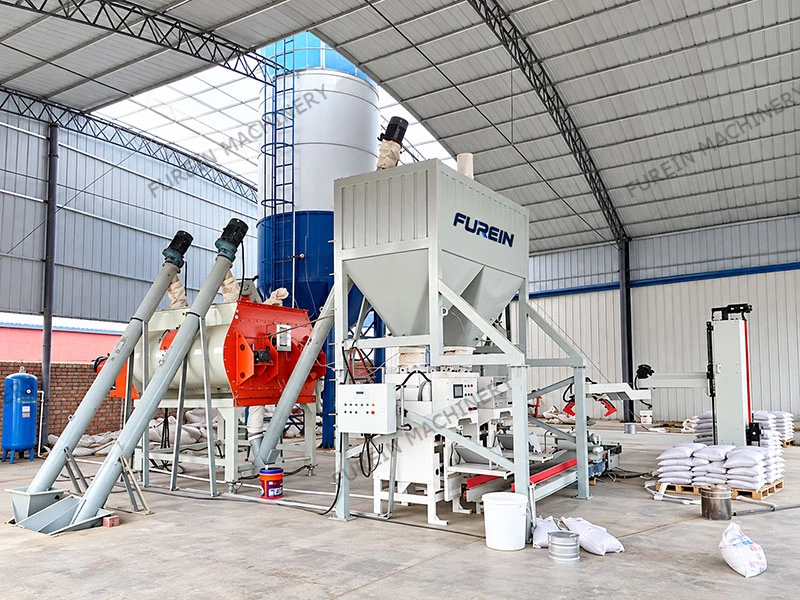
Fonctionnalité: Full Automation from Feeding to Palletizing
This compact small tile adhesive production line uses ground-level feeding and two material feeding lines connected to a double-shaft mixer. Après avoir mélangé, the finished material is transferred by screw conveyor to a double-outlet finished product hopper and packed by two air packing machines. The packed bags are then conveyed by belt conveyor to the palletizing area and stacked automatically by a column palletizer. Although the plant is compact, it achieves a complete automated process from feeding and mixing to packing and palletizing.
2–3 T/H Standard Tile Adhesive Production Line
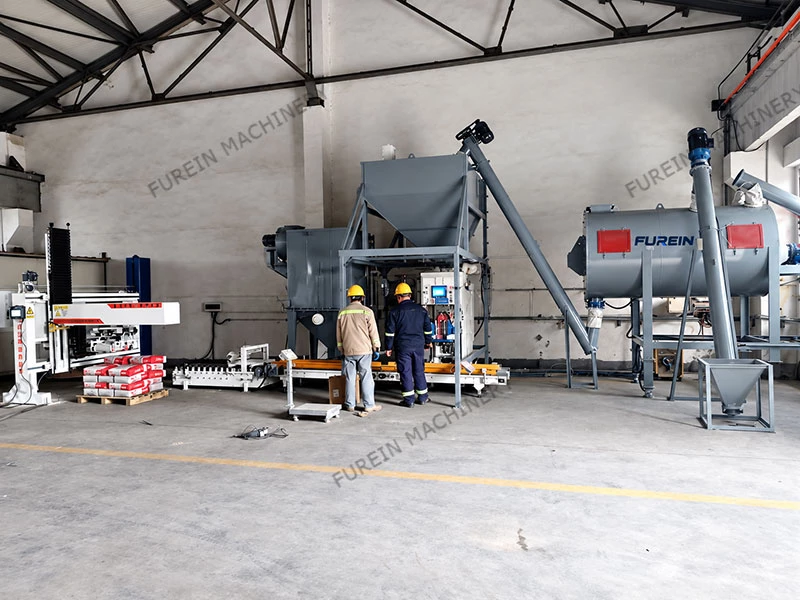
Fonctionnalité: Standard Compact Layout with Dust Collection and Palletizing
This 2–3 T/H small tile adhesive making machine uses ground-level feeding, with raw materials transferred by screw conveyor into the mixer. Après avoir mélangé, the finished material is packed by one air packing machine. The packed bags are then conveyed through a belt conveyor and bag shaping unit to the palletizing area, where a Cartesian palletizer stacks them automatically. A pulse dust collector is also included to improve the working environment and reduce dust during production.
Machine de fabrication d'adhésif pour carrelage améliorée
- L'amélioration de la capacité de la machine de fabrication d'adhésif pour carrelage à 10-15 t/h.
- Le malaxeur de colle pour carrelage est un malaxeur à double arbre.
- La sortie peut jusqu'à 12 t/h, adapté à la production en petite série. Faible investissement et faible encombrement.
- Lorsqu'un ensemble de petites machines de fabrication de colle à carrelage a été installé, en général, la hauteur de l'ensemble de la machine était inférieure à 3,5 m, et l'empreinte était inférieure à 2 mètres carrés.
- Il a adopté un mélangeur d'adhésif pour carreaux de ruban, et le temps de mélange par lots est d'environ 15 minutes par lot.


Machine de fabrication d'adhésif pour carrelage avec séchoir à sable
- La puissance du mélangeur de colle pour carrelage à double arbre détermine la sortie de la machine de fabrication de colle pour carrelage.
- Parfois, la teneur en humidité des matières premières est supérieure à 5%, généralement, un ensemble d'installations de séchage de sable est configuré pour sécher rapidement l'humidité du sable.
- Après séchage, le sable de séchage est rapidement placé dans une machine de fabrication d'adhésif pour carrelage pour un traitement ultérieur à travers un convoyeur à bande.
- Séchoir à sable est le meilleur partenaire des machines de fabrication de colle à carrelage.


Oui. A small tile adhesive making machine has a relatively simple structure and is easy to operate. FUREIN provides installation manuals, video guidance and installation instructions. If you still need help, our engineers can also travel to your country for on-site installation support.
A small tile adhesive production line normally needs about 2–3 workers. They mainly handle raw material feeding and bagging, including manually placing bags onto the packing machine.
The packing machine should match your bag type.
For valve bags, use a valve bag packing machine.
For open-mouth bags, use an open-mouth packing machine.
These machines normally handle bags from about 10–50 kg.
For smaller bags of around 1–10 kg, a small-dose packing machine is recommended.
It depends on your production needs. For a 1–8 T/H tile adhesive production line, an automatic weighing system can be added if large quantities of raw materials need to be weighed automatically. For additives used in small quantities, usually only tens or hundreds of kilograms for the whole production process, manual feeding is often more economical.
For a small tile adhesive production line, a ribbon mixer is usually sufficient.
A double-shaft mixer mixes faster, but the mixer speed must match the packing and storage capacity. A faster mixer alone will not increase the output of the whole production line.
For higher capacity, a double-shaft mixer can be used, but the storage and packing systems should also be upgraded.
Oui. The weighing system can be installed before the conveying system or below the tile adhesive mixer, depending on the feeding method and factory layout.
A small tile adhesive production line normally needs about 50 m² of floor space, with a workshop height of around 7 mètres. These dimensions are not fixed. FUREIN can design the layout according to your existing factory size and height.
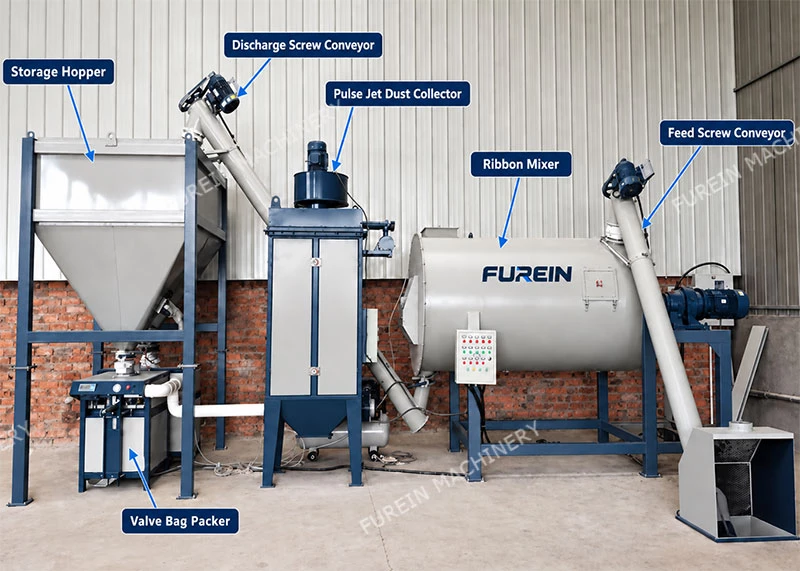
A small tile adhesive production line normally includes:
- Système d'alimentation
- Système de mélange
- Discharge system
- Système de stockage
- Système d'emballage
Optional equipment can include an automatic weighing system, dust collector and air compressor.
A small tile adhesive making machine usually costs about USD 3,000–8,000. The final price depends on the capacity, mixer type, Système d'alimentation, weighing system and packing machine.
Bigger capacity is not always better, and a more expensive machine is not always the right choice.
You should choose the tile adhesive making machine according to your current sales volume, expected demand and future production plan.
The capacity depends on the mixer size and the overall small tile adhesive production line configuration. Common options are: 1–2 T/H, 3–5 T/H, 5–8 T/H, and 8–10 T/H.
FUREINE can also provide tile adhesive production lines with capacities below 30 E.
A small tile adhesive making machine is a compact and flexible production line for small businesses or startups. Its typical capacity is 1–10 T/H, and it requires relatively little factory space.
Machine de fabrication d'adhésif pour carrelage: Le guide ultime de la FAQ
Composants de la machine de fabrication automatique de colle à carrelage?
- Silo à ciment boulonné amovible, généralement assorti à un élévateur à godets extérieur.
- Les silos à ciment sont souvent utilisés avec des stations de mélange de béton et des stations de mortier sec, il est détachable, nous l'appelions silo à ciment boulonné.
- Principalement utilisé pour stocker des matériaux en vrac tels que le ciment, cendres volantes, le sable, etc.
- Le fond du silo à ciment boulonné est un support en acier cylindrique, et la hauteur de décharge du silo à ciment peut être personnalisée en fonction de la situation réelle du client.

Machine de fabrication d'adhésif pour carrelage
Le système de mélange est conçu pour mélanger soigneusement les matières premières mesurées. Il comprend généralement un mélangeur, comme un mélangeur à ruban en spirale ou un mélangeur à palettes à deux arbres, ce qui garantit un mélange uniforme et rapide.
Mélangeur d'adhésif pour carrelage à palette à double arbre, il y a généralement une trémie de prémélange sur le dessus, et la trémie de production finale se trouve sous le mélangeur.
La machine de fabrication d'adhésif pour carrelage sans gravité est principalement utilisée pour le mortier anti-fissuration, mortier d'isolation thermique, mortier de liaison, mortier de surface, mortier de sol et autres matériaux en poudre avec des exigences élevées d'uniformité de mélange, comme le mortier sec, mortier de liaison, poudre de mastic, colle à carrelage, etc.

Système d'emballage
Vous pouvez choisir un machine à emballer automatique de valve, machine à emballer automatique à port ouvert, ou en vrac selon votre convenance.
• L'image de droite est une image de la machine à emballer les valves, qui a les caractéristiques d'une vitesse d'emballage rapide et d'une grande précision de pesage.
• Si votre sac est un sac d'emballage à valve, puis choisissez la machine à emballer de valve.
• Si votre sac est un sac ouvert, puis choisissez la machine à emballer à port ouvert.

Système de contrôle
Il y a 2 systèmes de contrôle pour vous de choisir, système de contrôle électrique et armoire de commande PLC.
PLC est l'abréviation de Programmable Logic Controller.
L'interface du système de contrôle PLC est simple et facile à comprendre, facile à utiliser, élevé en automatisation, économiser du travail et améliorer l'efficacité de la production.

Système de dépoussiérage
Vous pouvez choisir entre un dépoussiéreur à impulsions et un dépoussiéreur économique.
Le dépoussiéreur à impulsions à haut rendement peut vous aider à mieux collecter la poussière et à purifier l'environnement.
Le filtre à manches pour machine à emballer est économique et peut vous aider à ramasser les poussières à moindre coût.

Principe de fonctionnement de la machine de fabrication de colle à carrelage
Un organigramme précis peut vous aider à voir le profit et une meilleure disposition de votre machine de fabrication de colle à carrelage.
Principe de fonctionnement: Comme le montre la figure ci-dessous, la partie gauche est l'usine de séchage du sable, et la partie droite est la machine automatique de fabrication d'adhésif pour carrelage.
Le processus de travail de la machine de fabrication d'adhésif pour carrelage est le suivant: première, pour ajouter du matériel à l'élévateur à godets extérieur, le matériau sera livré au silo à ciment par élévateur à godets, le fond du silo à ciment est doté d'un convoyeur à vis, le matériau à travers le convoyeur à vis jusqu'à l'élévateur à godets intérieur, Ensuite, le matériau arrivera dans la trémie de pré-mélange en attente de mélange, puis le matériau transporté vers le mélangeur de mortier sec à double arbre pour le mélange, le matériau du puits mélangé entrera dans l'entrepôt de produits finis, il y a un système d'emballage, la machine à emballer automatique de sac de valve emballera le produit fini dans des sacs.
Paramètre de la machine de fabrication de colle à carrelage

La sortie de la machine de fabrication d'adhésif pour carrelage simple comprend 1-2T/H, 3-4E, 5-6T/H et 6-8T/H.
La production de l'usine automatique de colle à carrelage est de 10-15 t/h, 15-25 e, 25-35 e, et le maximum peut atteindre 100 e.
Si vous voulez connaître une liste spécifique de machine de fabrication de colle à carrelage personnalisée, ou des solutions personnalisées, N'hésitez pas à nous contacter.
Quelle est la capacité d'une machine de fabrication de colle à carrelage?
En général, la sortie de la machine de fabrication d'adhésif pour carrelage est de 0,5 t/h ~ 100 t/h.
La petite machine de fabrication d'adhésif pour carrelage adopte un mélangeur d'adhésif pour carrelage à ruban à trois couches et sa gamme de processus est:0.5t/h à 8 e.
Si vous voulez une petite capacité de machine de fabrication de colle à carrelage jusqu'à 10 t/h, c'est OK. Contactez-nous pour obtenir une solution maintenant.
L'usine d'adhésif pour carrelage avec mélangeur de mortier en apesanteur à double arbre a une capacité de 8 t/h à 60 t/h. Si vous voulez atteindre la sortie de 100 t/h ou 150 t/h, ce n'est pas un problème, veuillez nous contacter pour des solutions personnalisées.
Un ensemble de machines de fabrication de colle à carrelage peut non seulement produire de la colle à carrelage, mais aussi produire d'autres mortiers secs, donc on peut l'appeler machine à mortier de mélange sec, usine de mortier sec, ligne de production de mortier sec, usine de fabrication de colle à carrelage, machine de fabrication de mastic mural, Usine de plâtre prêt à l'emploi, etc.
Avantages de l'utilisation d'une machine de fabrication de colle pour carrelage:
Efficacité accrue: L'automatisation et l'intégration de divers composants dans la machine réduisent le travail manuel et augmentent l'efficacité de la production.
Qualité constante: La machine assure un mélange uniforme et une mesure précise des matières premières, résultant en des colles à carrelage de haute qualité.
Options de personnalisation: Le système de contrôle permet une flexibilité dans l'ajustement des formulations adhésives, répondre aux exigences spécifiques des différents projets.
Économies de coûts: En produisant en interne des colles à carrelage, les entreprises de construction peuvent réduire leurs coûts par rapport à l'achat d'adhésifs préfabriqués.
En conclusion, une machine de fabrication de colle à carrelage est un outil essentiel pour produire des colles à carrelage de haute qualité. Il permet d'être efficace, cohérent, fabrication sur mesure, fournir aux projets de construction des solutions de liaison fiables et durables.


