Descrição do Projeto
10–15 T/H Planta de argamassa de mistura seca multiprodutos na Tailândia
This multi-product dry mix mortar plant in Thailand was designed for a customer who wanted to produce several dry-mix products on one production line rather than build a separate line for each product.
The planned product range included C1 and C2TE tile adhesive, ready-mix plaster, sanded grout and 1K cementitious waterproofing mortar.
The main mixing line was planned at 10–15 T/H, with an integrated sand drying and screening section. Compared with a single-product line, the real difficulty was not the mixer capacity itself. We had to look at raw-material storage, wet-sand preparation, recipe changes, low-dose additives, different bag weights and cleaning between products as one complete system.
Project Overview
| Project Item | Configuração |
|---|---|
| Localização | Thailand |
| Capacidade | 10–15 T/H multi-product planta de argamassa de mistura seca com 3-5 º sand drying line in Thailand |
| Product Types | 5 |
| Produtos Principais | C1/C2TE tile adhesive, gesso, grout, 1K waterproofing mortar |
| Areia | Wet bulk sand |
| Sand Preparation | Secagem + triagem |
| Main Raw Materials | Cimento, areia de sílica, carbonato de cálcio / mineral fillers |
| Additives | RDP, HPMC, starch ether, pigmentos, hydrophobic additives |
| Additive Feeding | Mainly manual in final configuration, automatic micro-dosing reserved as a future option |
| Bag Sizes | 20 kg / 25 kg / 40 kg valve bags |
| Production Concept | One flexible line for multiple formulations |
Why This Was a Multi-Product Dry Mix Mortar Plant?
The customer wanted to use one production line for five different dry-mix products. Although these products share some major raw materials, their formulations are not the same. Cimento, sand and mineral fillers are used in larger quantities, while RDP, HPMC, starch ether, pigments and hydrophobic additives are used in much smaller amounts. So before we talked about the mixer, we first had to separate the materials into two groups:
major raw materials that could be stored and weighed automatically;
low-dose additives that needed a different feeding method.
This decision affected the silo arrangement, batching system, additive feeding method and even how the customer would change from one product to another later.
The Sand Had to Be Dried Before Mixing
The customer planned to use bulk wet sand, so the plant needed a sand preparation section before the main mixing line.
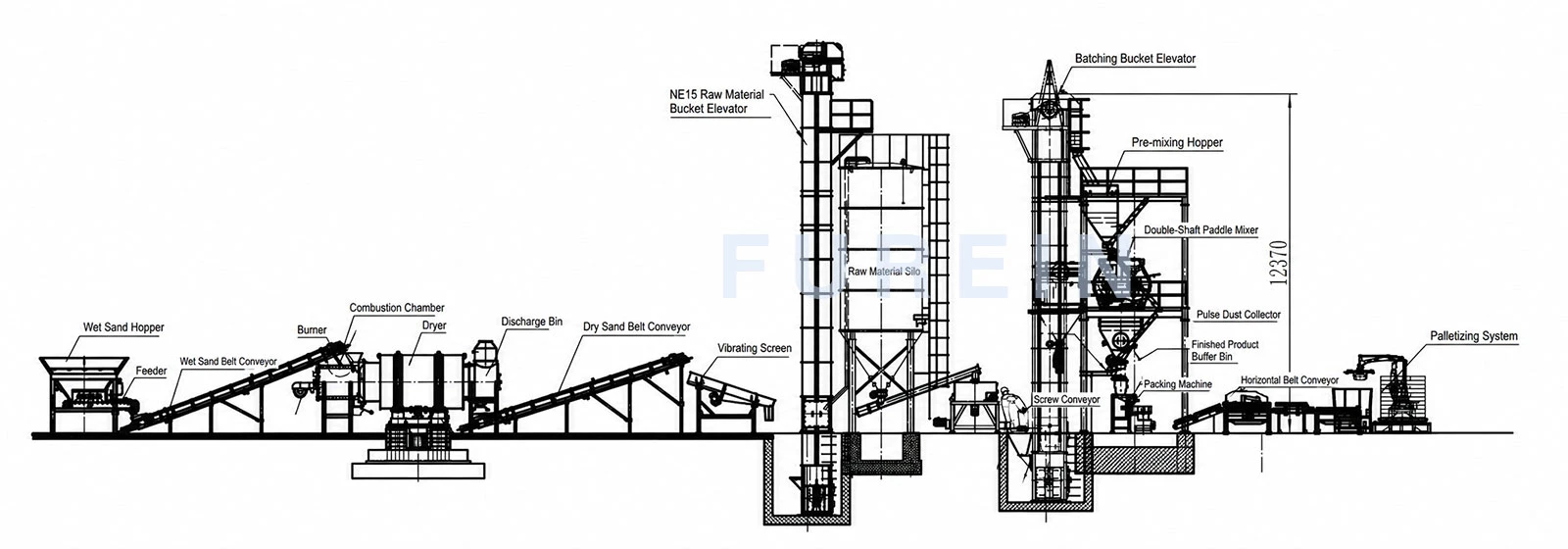
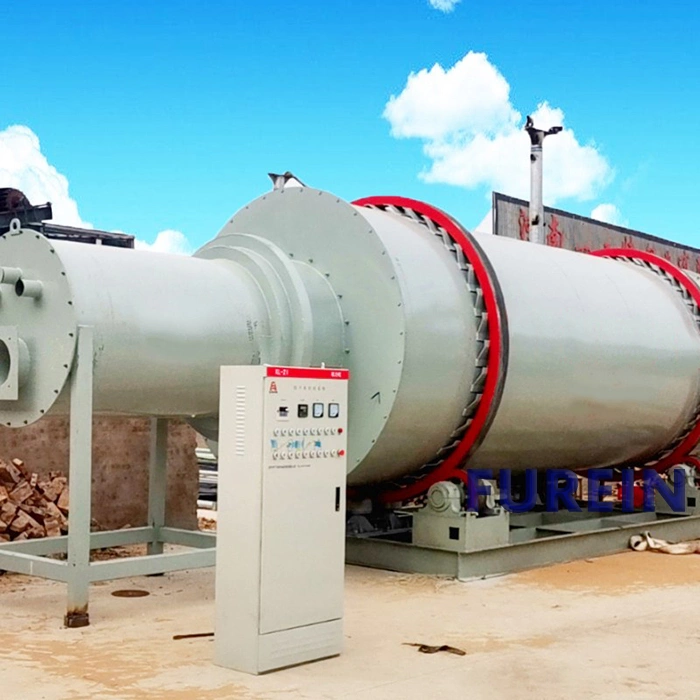
The customer originally referred to a three-cylinder rotary dryer with a capacity of around 3–5 T/H.
One thing we discussed carefully was that dryer capacity cannot be judged only by the nameplate number. Incoming sand moisture has a direct effect on actual output. If the sand contains more water, the dryer must remove more moisture, so the amount of finished dry sand produced per hour will decrease. This matters because the main mixing line was planned at 10–15 T/H. If the dryer only supplies several tons of dry sand per hour, the main line cannot necessarily run continuously at full capacity.
Nesse caso, there are usually two practical options: prepare and store dry sand in advance; or increase drying capacity if continuous high-output production is required. For us, the important point was to treat sand drying capacity and mixing capacity as two separate calculations.
Raw-Material Storage Was Based on Usage, Not Just Capacity
The customer asked us to recommend storage for cement, wet sand, prepared dry sand and mineral fillers. We did not decide the number of silos only from the 10–15 T/H capacity.
For each raw material, we looked at:
how much is used per day;
how the material arrives at the factory;
how often it is delivered;
whether it must be kept separate from other materials.
Por exemplo, bulk cement is suitable for silo storage and pneumatic filling. Dry sand needs enough buffer storage so the mixing line can continue working even if the dryer pauses. Calcium carbonate and other mineral fillers can be handled differently depending on whether the customer finally receives them in bulk or jumbo bags.
So the more useful question is not: “How many silos does a 10–15 T/H plant need?” It is “How many major raw materials need separate storage, and how much buffer stock does each one need?”
Automatic Batching Was Used for the Main Raw Materials
For cement, dry sand and mineral fillers, automatic weighing is practical because these materials are used in relatively large quantities in every batch. Once the recipe is selected, the control system can call for the required quantity of each major material and send it to the mixer according to the production sequence. This gives the customer better batch-to-batch repeatability and reduces the amount of manual weighing. It also makes switching between products easier. A C1 tile adhesive recipe and a waterproofing mortar recipe may use different material ratios, but the same main batching system can still be used by changing the recipe settings. For a multi-product plant, this flexibility is more important than simply making one fixed product at the highest possible speed.
Why the Customer Initially Wanted Automatic Micro-Dosing?
At the beginning of the project, the customer wanted an automatic precision dosing system for RDP, HPMC, starch ether, pigments and other low-dosage additives.
This request was reasonable. Some additives in the customer's formulations could be as low as approximately 0.05% of the total batch weight. When the dosing quantity becomes very small, the weighing system must also become much more sensitive.
Por exemplo, a weighing system designed to handle kilograms of material accurately is not automatically suitable for accurately dosing a much smaller quantity.
The lower the minimum dosing quantity, the more attention has to be paid to weighing resolution, feeder control, material flow and repeatability.
That is why “automatic additive dosing” is not one standard machine with one standard price.
Why the Customer Finally Kept Small Additives Manual?
After we checked the actual dosing range more carefully, the cost changed quite a lot. For the very small-dose ingredients, better accuracy required more precise feeders, smaller weighing units, additional storage bins and more control components.
At that point, the customer had to compare two things: how much better the dosing accuracy would be and how much additional investment was required to achieve it.
After going through the cost, the customer decided not to install the complete automatic micro-dosing system in the first stage. For now, these small additives are added manually according to the recipe. The plant can still be upgraded later if production volume increases or if the customer decides that tighter additive control is worth the investment. From our side, this was a reasonable decision. There is no need to pay for a complicated system now if the current production scale does not justify it.
One Mixing Line for Different Mortar Formulations
The main mixing system needed to handle products with different formulations rather than one fixed recipe. C1 and C2TE tile adhesive, gesso, grout and waterproofing mortar all have different material ratios and additive requirements. The main batching system can change the quantities of cement, sand and fillers according to the selected recipe, while the additives are added according to the corresponding formulation. This allows the same main production line to be used for different products.
No entanto, product flexibility also brings another issue: cleaning. The more products a factory plans to produce on one line, the more important it becomes to consider residual material inside the mixer, conveyors and packing section.
Cross-Contamination Was Especially Important for Pigments
The customer also asked how cross-contamination between different formulations and colours could be reduced. This becomes more important once pigments are involved. Changing from one gray mortar to another is usually easier than changing from a colored grout to a light-colored tile adhesive. For this reason, the production sequence should also be planned.
Products with similar colors or similar formulations can be produced together before changing to a very different product. The mixer and conveying points where powder can remain should also be easy to inspect and clean. If the customer later produces many strongly colored products, some feeding or packing components may eventually be better separated.
The Packing Section Had to Handle 20 kg, 25 kg and 40 kg Bags
The customer's planned packaging sizes were not identical. C1 and C2TE tile adhesive were planned for 25 kg valve bags, ready-mix plaster for 40 kg bags, and grout and 1K waterproofing mortar for 20 kg bags.
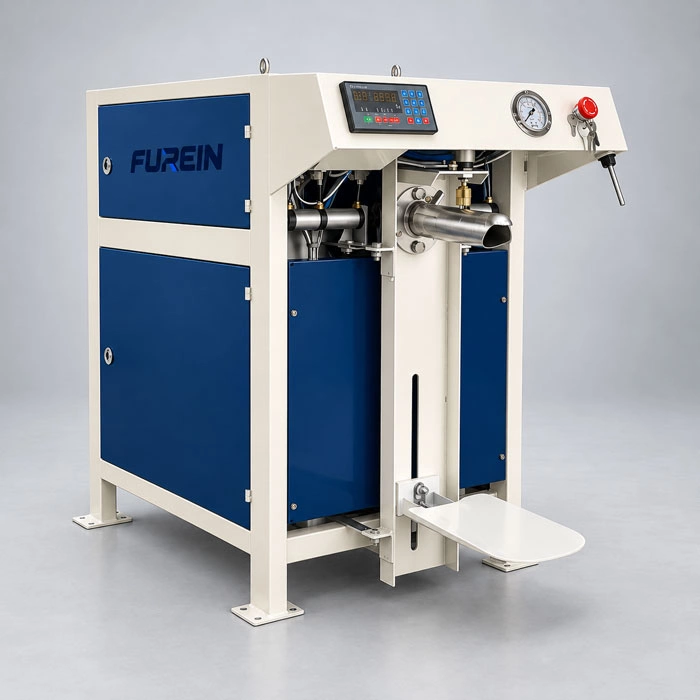
This meant the packing section needed to handle 20 kg, 25 kg and 40 kg valve bags.
For this type of project, the packing machine should not be selected only according to its maximum bags per hour. We also need to check whether the weighing range covers all required bag sizes and whether switching between target weights is convenient for the operator. Packing capacity must also be matched with the output of the mixer. Por outro lado, the mixer may finish material faster than the packing section can handle it.
How the Final Plant Was Arranged?
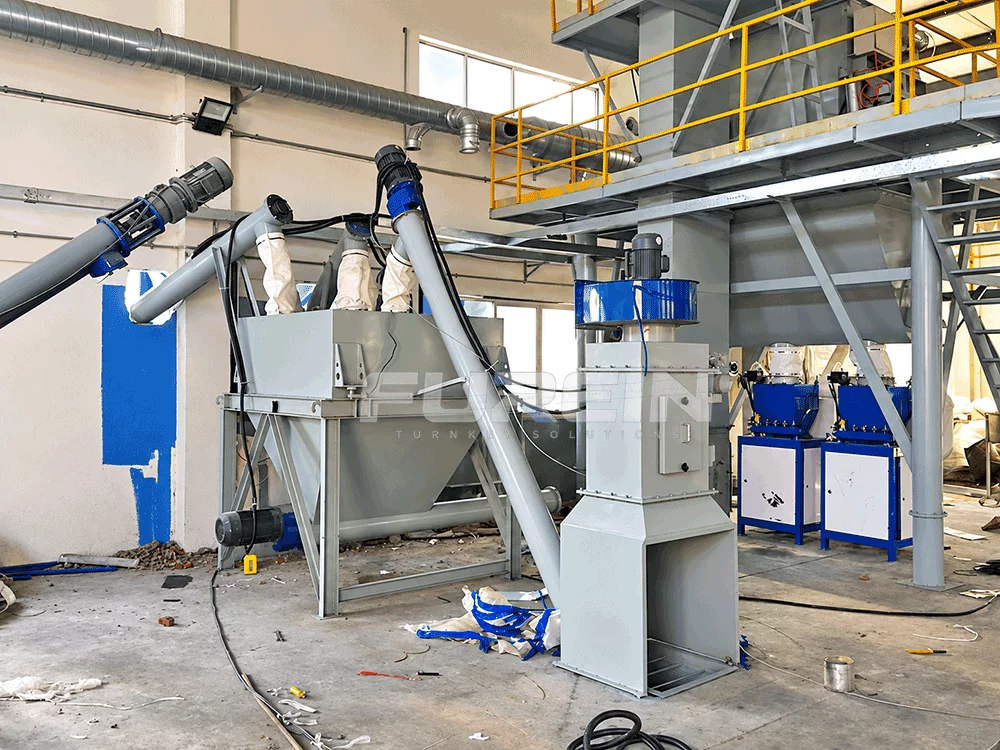
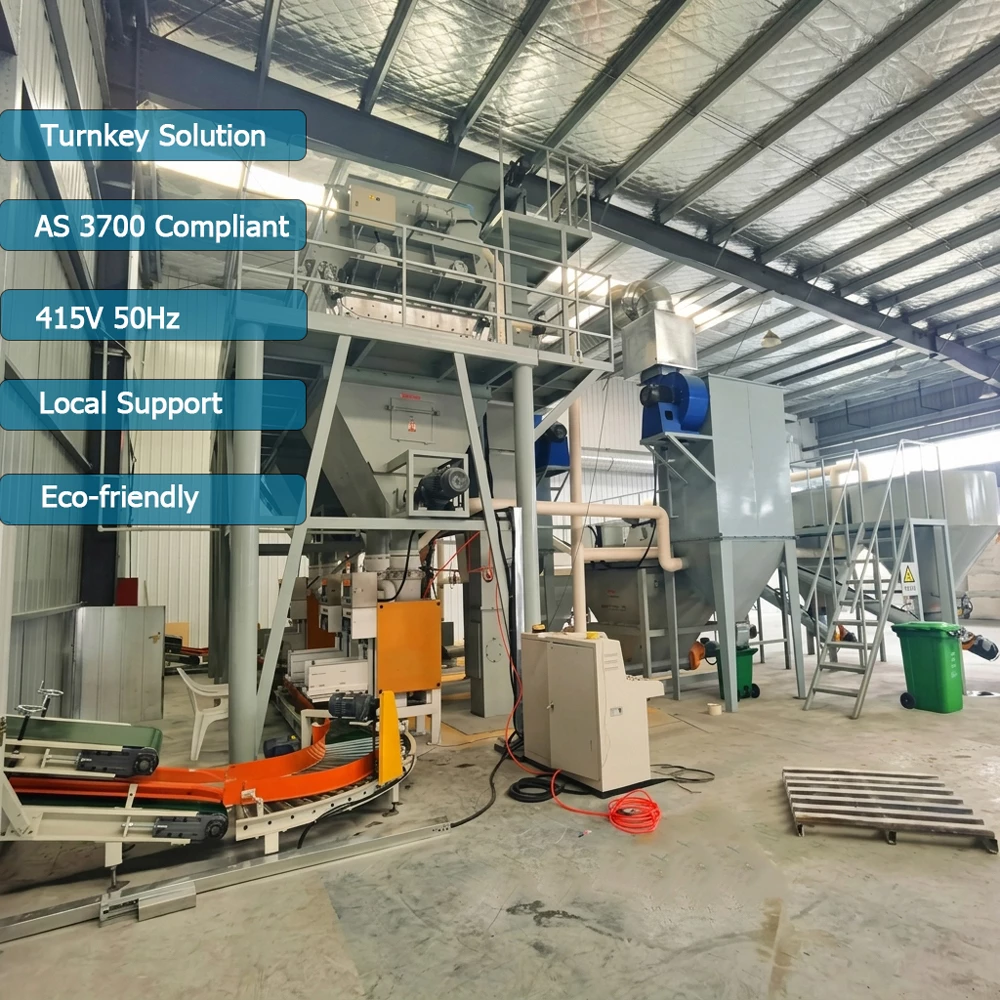
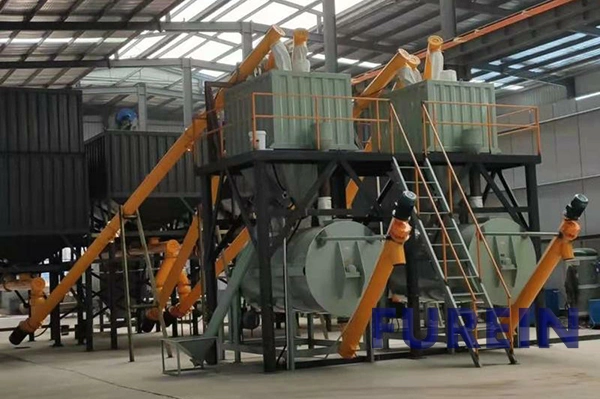
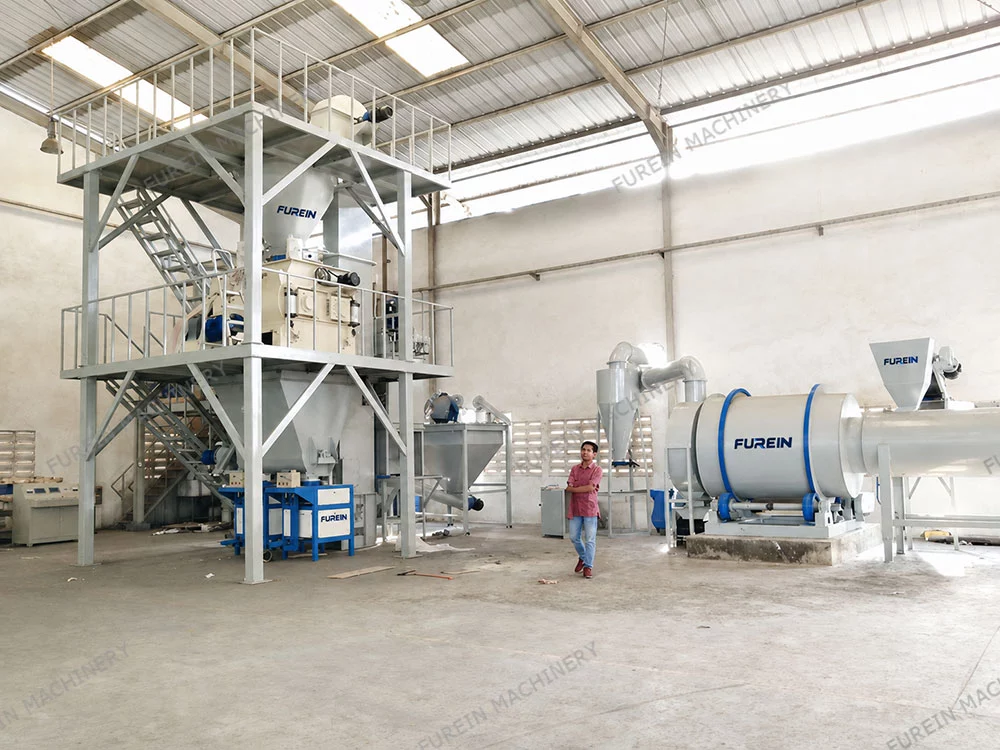
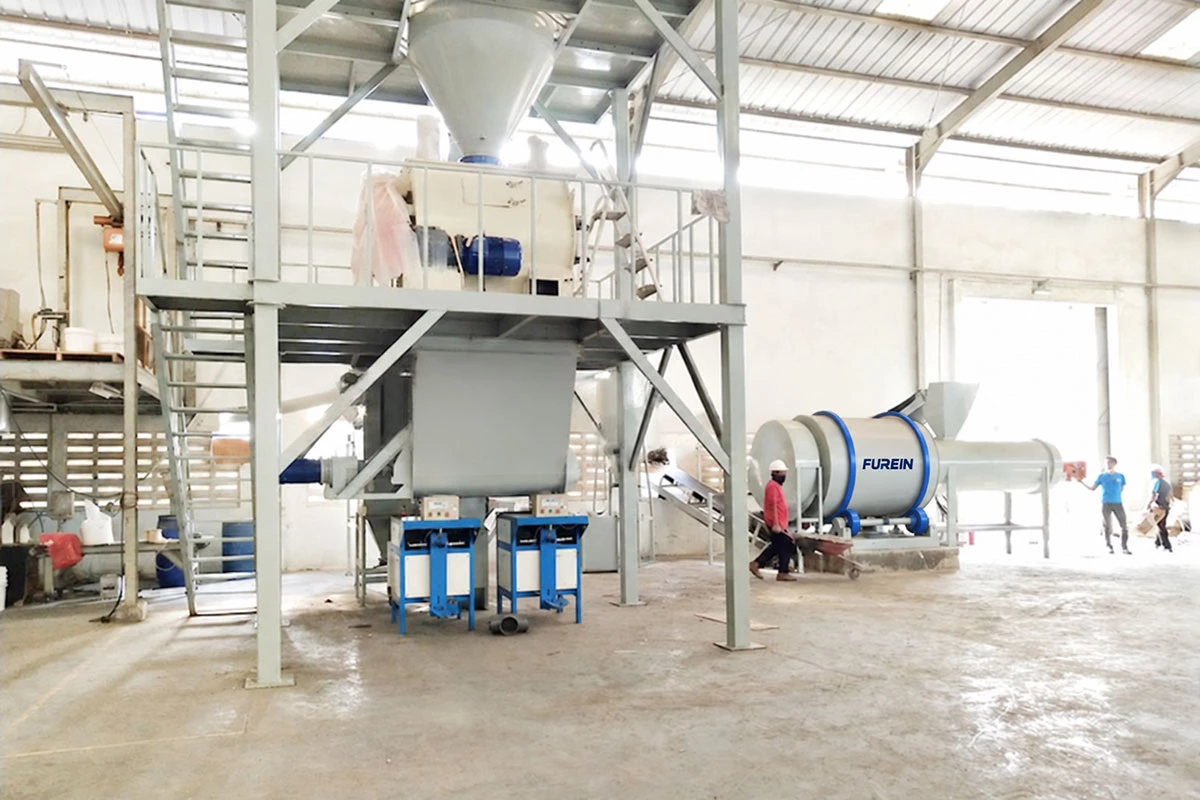
The final plant combined the main dry-mortar production tower with a separate sand-drying section. In the onsite photo, the main production structure is arranged on one side of the workshop, while the rotary sand dryer and related handling equipment are installed separately.
We preferred this arrangement because sand preparation and mortar mixing are two different stages. The wet sand is dried and screened first, then transferred into storage before entering the automatic batching and mixing system. Keeping the drying section separate also makes maintenance easier and keeps the main production structure less crowded.
What Can You Learn from This Project?
Looking back at this Thailand project, the nominal 10–15 T/H capacity was actually not the most difficult part. The more important decisions were around the materials and the way the customer planned to operate the factory. A few points are worth remembering if you are planning a similar multi-product dry mix mortar plant.
Do not judge the whole plant only by mixer capacity
A 10–15 T/H mixer does not automatically mean the complete plant can continuously produce 10–15 T/H. Secagem, batching and packing all need to keep up.
Check your sand condition first
Se você usar areia molhada, moisture content has a direct effect on actual dryer output.
Calculate the smallest additive dosage
This number is one of the most important factors when deciding whether automatic micro-dosing is worth the cost.
Do not automate everything automatically
In this project, the customer originally wanted full automatic additive dosing, but after checking the very small dosage and additional cost, manual feeding was more reasonable for the first stage.
Think about cleaning before producing many products
If one line will make tile adhesive, grout, plaster and waterproofing mortar, product changeover needs to be considered before the equipment is finalized.
Give the supplier all bag sizes at the beginning
20 kg, 25 kg and 40 kg bags place different requirements on the packing section.
These details normally affect the final plant configuration more than the simple headline capacity.
FAQs for multi-formula dry mortar production line
Sim. In this Thailand project, the same main line was planned for C1 and C2TE tile adhesive, ready-mix plaster, sanded grout and 1K waterproofing mortar. The main batching and mixing equipment can be shared, but recipe management, additive feeding and cleaning between products need to be considered.
Not necessarily. If dry sand can be prepared and stored in advance, a smaller dryer can work longer hours before the main line starts. But if you want continuous 10–15 T/H production, the dryer must supply enough dry sand to support that output. Incoming sand moisture is one of the key factors.
The customer originally wanted automatic dosing for RDP, HPMC, starch ether, pigmentos e outros aditivos. After checking the smallest dosage, we found that the very low-dose materials required more precise feeding and weighing equipment. The cost increased considerably, so the customer decided to keep this part manual for the first stage and leave the option open for a future upgrade.
Sim, if the selected machine has a suitable weighing range and the required packing speed can still be achieved. For this project, the customer needed all three bag weights, so the packing section had to be selected around both weight range and throughput.
A reasonable production sequence helps a lot. Products with similar colors or formulations can be produced together, while major product changes should be followed by proper cleaning. The mixer and conveying points where powder may remain should also be easy to access.
Planning a Similar Multi-Product Dry Mix Mortar Plant?
Before we recommend equipment, the most useful information is not simply “I need a 10 T/H plant.”
It is better to tell us: your planned products, main raw materials, sand moisture, required production capacity, minimum additive dosage, number of formulations, bag sizes and available workshop space.
With this information, we can first decide which parts should be automated, which materials should be stored separately and where additional equipment would actually bring value. That normally results in a more practical plant than simply choosing the most automated configuration