Descrição do Projeto
8–Linha de produção automática de adesivo para azulejos de 10 T/H no Kuwait
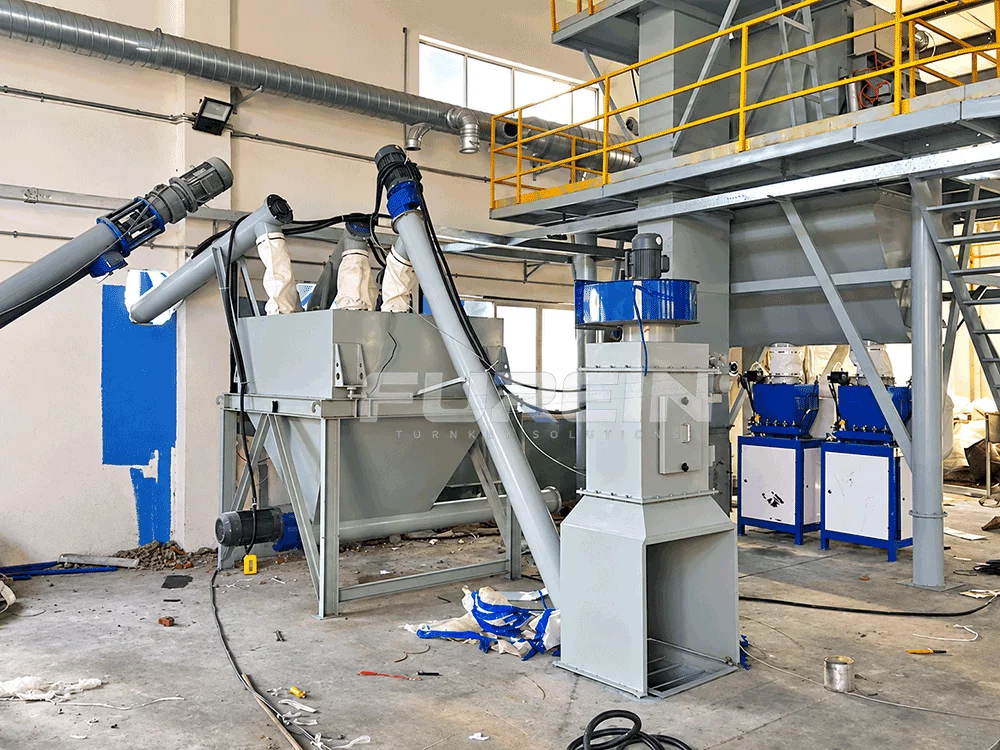
This project is an 8–10 T/H automatic tile adhesive production line installed in Kuwait.
The customer planned to produce tile adhesive in 25 kg valve bags. The production line needed to handle sand, cimento, other powder materials and small additives, while completing material storage, pesagem automática, mixing and packing in one system.
The customer also had several clear project conditions from the beginning:
- target capacity of 8–10 tons per hour;
- 25 kg valve bag packing;
- four raw-material silos;
- approximately 20 × 15 m available installation area;
- 415 V / 50 Hz local power supply;
- automatic weighing and batching;
- centralized control;
- dust collection;
- and special attention to the high-temperature working environment in Kuwait.
These requirements determined how the production line was configured.
Kuwait Tile Adhesive Production Line at a Glance
| Item | Project Configuration |
|---|---|
| Inscrição | Adesivo para azulejos |
| Localização | Kuwait |
| Capacidade | 8–10 T/H |
| Main package | 25 kg valve bag |
| Sand size | Approx. 500 μm |
| Main raw materials | Areia, cimento, other powder materials, aditivos |
| Main silo arrangement | 60 m³ + 50 m³ × 2 + 25 m³ |
| Additive feeding | Manual |
| Mixer | Twin-shaft paddle mixer |
| Power supply | 415 V / 50 Hz |
| Suggested installation area | Approx. 20 × 15 m |
| Control | Centralized automatic control |
What Did the Customer Need to Produce?
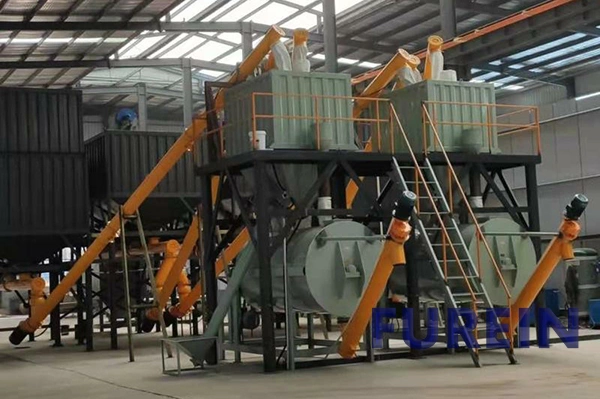
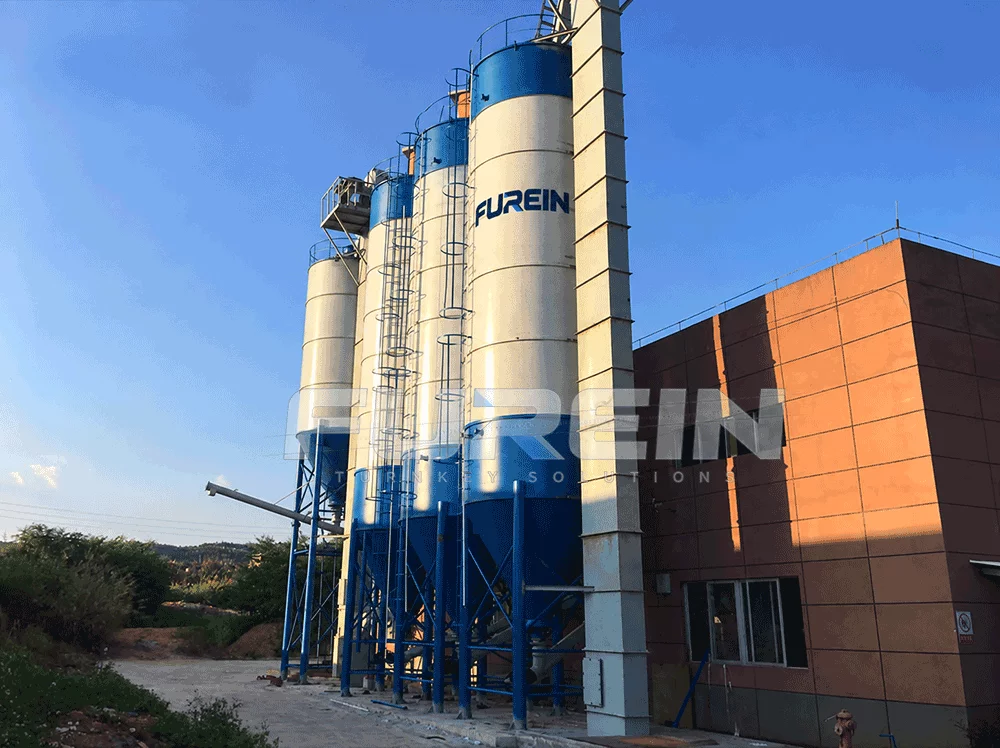
When we first discussed this dry mortar making project with the Kuwait customer, the key point was not simply the required output of the tile adhesive line. We first needed to understand how their raw materials would actually enter the plant and how each material should be handled. In this project, the customer planned to use sand, bulk cement, another powder material and a small amount of additives. The sand would be fed from jumbo bags or the feeding point, lifted by bucket elevator and stored in two 50 m³ sand silos. Bulk cement would be delivered by cement tanker and pneumatically conveyed into a 60 m³ cement silo, while the other powder material would be transferred into a 25 m³ powder silo through a separate feeding and pneumatic conveying system.
For the small additives, we did not recommend making the system unnecessarily complicated. Since the dosage was limited, manual feeding was more practical for this tile adhesive plant. From our experience during the discussion, this is one of the points that has to be confirmed early when designing a tile adhesive production line. The number of raw materials, how they arrive at the factory, whether the sand is already dried, the required bag size, weighing accuracy and available workshop space all affect the final configuration. We therefore arranged the feeding and storage system according to the actual supply method and consumption of each material, instead of using the same feeding method for every ingredient.
Why Were Four Silos Used?
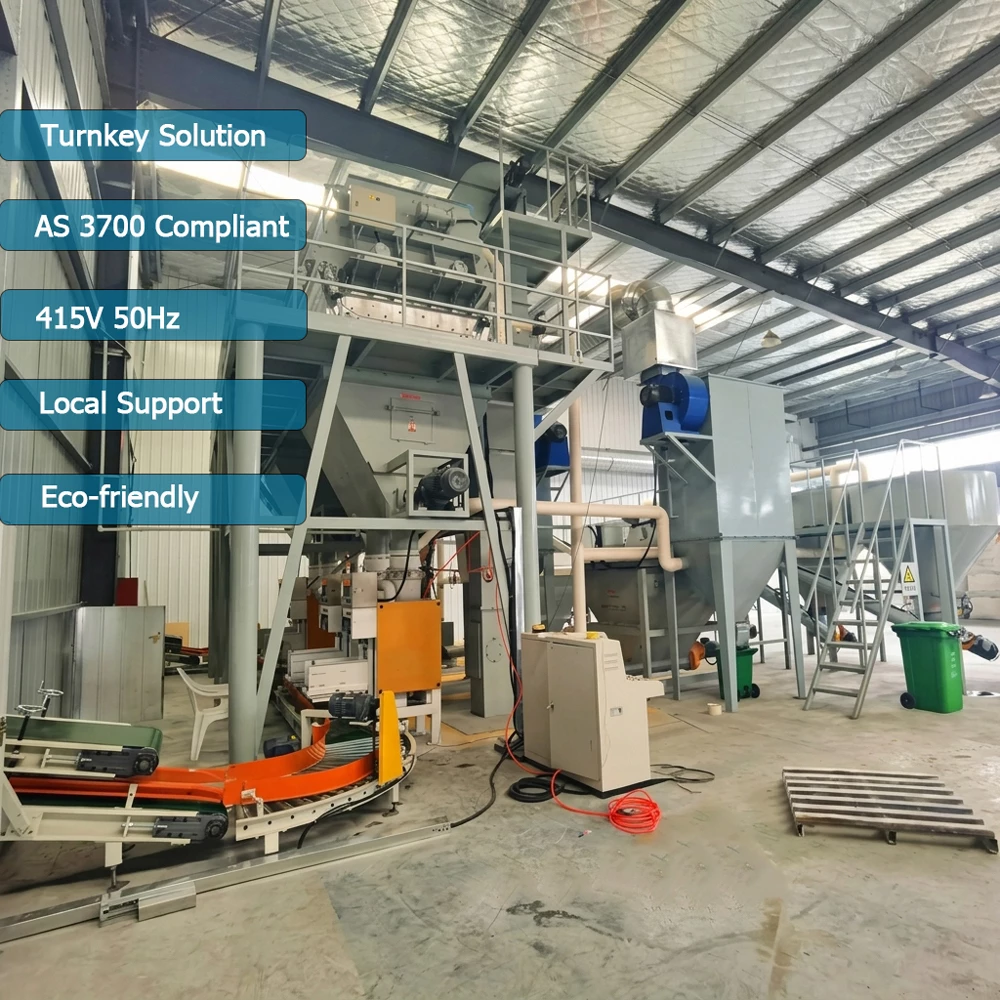
The customer proposed an installation area of approximately 20 m × 15 m, which was sufficient for this project. The storage section was designed around four silos: one 60 m³ silo, two 50 m³ silos and one 25 m³ silo, based on the customer’s main raw materials and storage needs. To keep the indoor structure more manageable, the tallest parts of the system, including the bucket elevator and the silos, were arranged outdoors. This helped us control the required height inside the workshop and made the overall layout more practical for the customer’s existing building.
Inside the plant, we used vertical material handling as much as possible. The bucket elevator, silos, weighing hoppers, misturador, finished-product hopper and packing equipment were arranged at different levels so that gravity could be used wherever practical. This reduces unnecessary horizontal conveying and keeps the production flow more compact. For customers who already have a workshop, this kind of vertical arrangement is often more useful than simply choosing a smaller machine, because the real question is whether the whole tile adhesive process can fit and operate smoothly within the available space.
One point we always explain to customers is that the number of silos should not be selected only according to plant capacity. It should be based on how many major raw materials need separate storage, the daily consumption of each material, how often materials are delivered, and whether different sands or powders must be stored separately. Em outras palavras, the silo arrangement should follow the actual production process. That is why we normally confirm the plant layout before finalizing the equipment configuration.
How Was the 20 × 15 m Plant Area Used?
The customer proposed an installation area of approximately 20 m × 15 m, which was sufficient for this project. The storage section was designed around four silos: one 60 m³ silo, two 50 m³ silos and one 25 m³ silo, based on the customer’s main raw materials and storage needs. To keep the indoor structure more manageable, the tallest parts of the system, including the bucket elevator and the silos, were arranged outdoors. This helped us control the required height inside the workshop and made the overall layout more practical for the customer’s existing building.
Inside the plant, we used vertical material handling as much as possible. o elevador de balde, silos, weighing hoppers, misturador, finished-product hopper and packing equipment were arranged at different levels so that gravity could be used wherever practical. This reduces unnecessary horizontal conveying and keeps the production flow more compact. For customers who already have a workshop, this kind of vertical arrangement is often more useful than simply choosing a smaller machine, because the real question is whether the whole tile adhesive process can fit and operate smoothly within the available space.
One point we always explain to customers is that the number of silos should not be selected only according to plant capacity. It should be based on how many major raw materials need separate storage, the daily consumption of each material, how often materials are delivered, and whether different sands or powders must be stored separately. Em outras palavras, the silo arrangement should follow the actual production process. That is why we normally confirm the plant layout before finalizing the equipment configuration.
Automatic Weighing Before Mixing
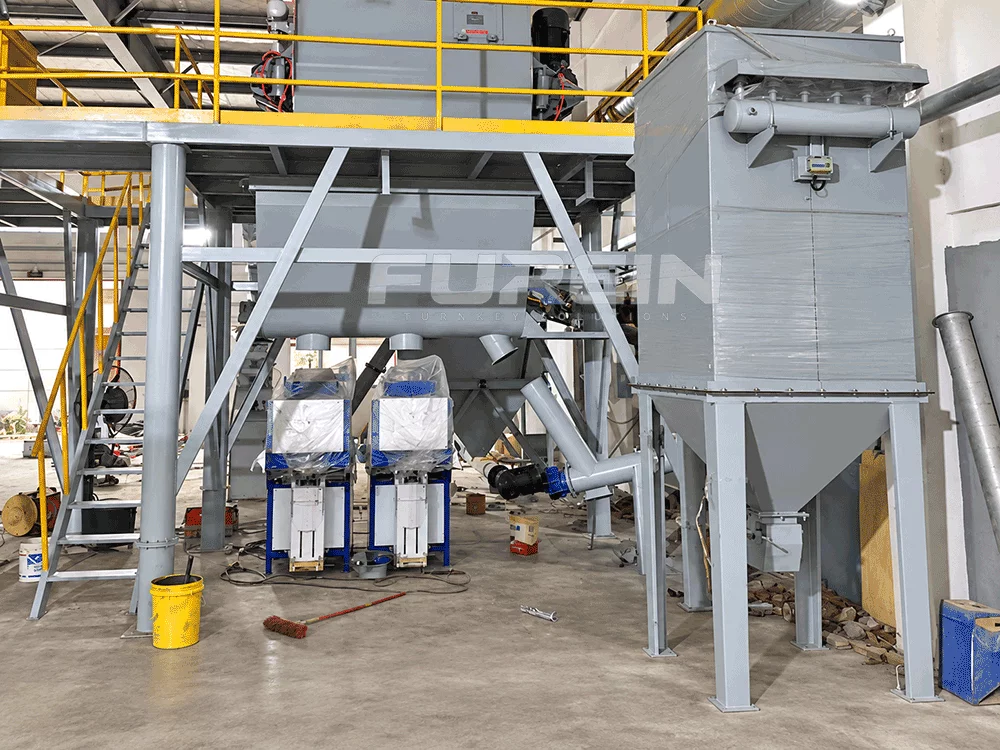
For the main raw materials, we designed the system to use automatic weighing rather than asking operators to measure each batch manually. The weighing section includes an automatic weighing hopper, load cells and pneumatic valves, with the original project requirement setting the static weighing error target below ±2%. During the technical discussion, three 1.5-ton load cells were specified, with KELI or another reliable brand as the preferred option. For tile adhesive production, this part is worth doing properly because stable product quality starts with stable batching. If the same formula cannot be repeated accurately from batch to batch, even a good mixer cannot solve the problem afterwards.
For the minor additives, we took a different approach. Because the dosage is small, we did not recommend adding a separate automatic dosing system just to make the line look more “automatic.” That would increase cost and make the system more complicated without bringing much practical value. Instead, we designed a small manual additive feeding port on the screw conveyor connected to the weighing system, so the operator can add these materials directly when required. This keeps the main raw materials automatically controlled while leaving the small-dose ingredients simple and easy to handle. In our experience, this is usually a more practical balance between automation, investment and daily operation for a 8-10 tph tile adhesive production line.
Twin-Shaft Paddle Mixer for Tile Adhesive
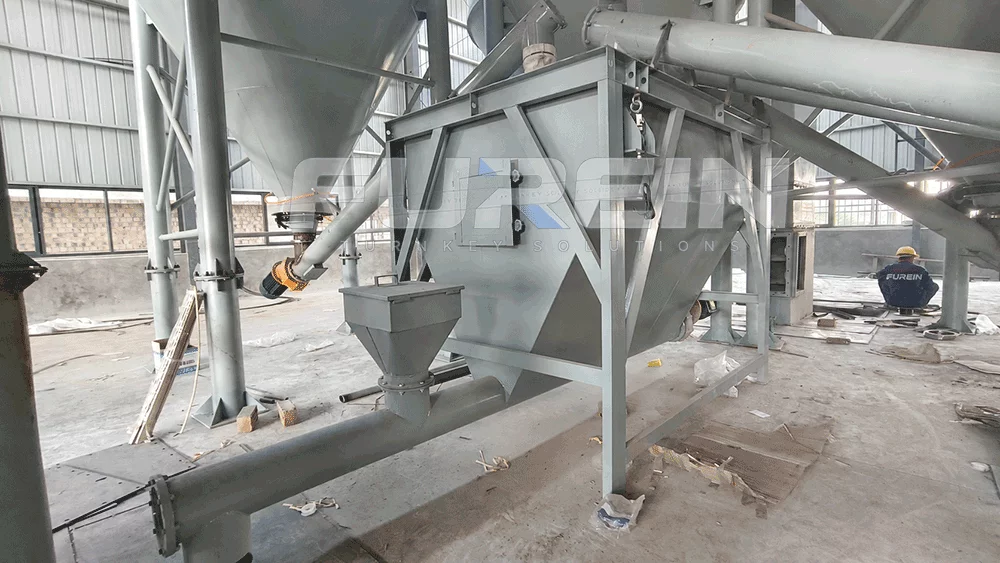
For this project, we selected a twin-shaft paddle mixer with a working batch of about 1 tonelada. The two shafts rotate in opposite directions to create fast cross-mixing, with the target mixing time around 1–1.5 minutes under suitable conditions. 6-8 minutes produce one batch of tile adhesive. No entanto, when sizing a tile adhesive production line, we never look at mixer volume alone. The real output depends on the complete cycle—feeding, pesagem, misturando, discharge and packing.
Finished Product Hopper and Packing Section
After mixing, the finished tile adhesive is discharged into a buffer hopper before entering the packing section. This allows the mixer to continue the next batch without waiting for all bags to be filled, so the mixing and packing sections can work more independently. For this project, the customer required 25 kg valve bags.
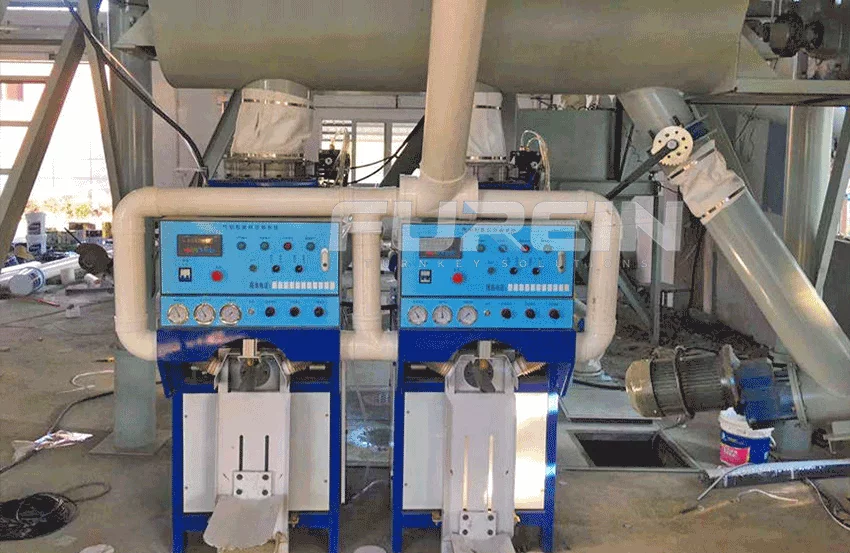
Our máquina de embalagem de saco de válvula can fill about 6–7 bags per minute for 25 kg bags. Considering the operator’s bag-placement speed and the target output of 10 º, two packing machines are sufficient for this line. The customer also requested a packing tolerance of ±200 g, so the packing configuration had to be selected around both capacity and weighing accuracy.
Siemens PLC Control System
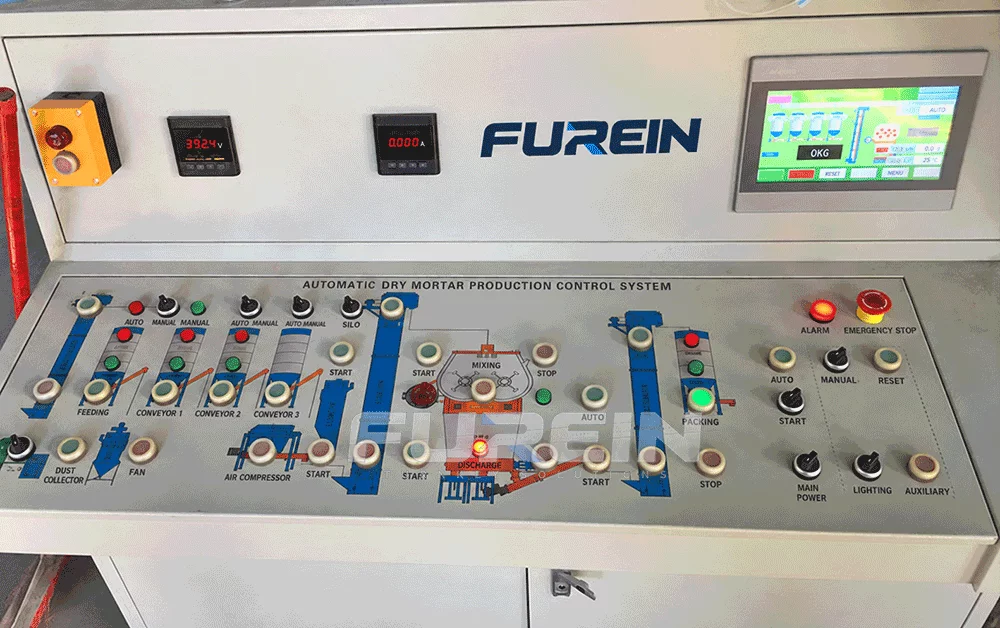
The tile adhesive production line uses a centralized PLC control system, so the operator can manage the main equipment, automatic weighing and feeding sequence from one control panel. The customer required PLC control, touchscreen HMI, automatic and manual operation, process display and alarm functions. For this project, the control cabinet also needed a cooling system because of the local working environment.
The customer specifically asked for Siemens, so we clarified one point before finalizing the electrical configuration: did they mean only the PLC should be Siemens, or all major electrical components inside the cabinet as well? This makes a big difference in cost and lead time. When comparing quotations, it is better to confirm exactly which parts must be Siemens—PLC, HMI, inverter, breakers, contactors, motors, or the complete control cabinet—rather than simply writing “Siemens control system.”
Planning a Similar Tile Adhesive Production Line?
If you are preparing a tile adhesive factory, the following information is enough for us to make a preliminary configuration.
- Required production capacity in tons per hour.
- Tile adhesive formula or main raw-material list.
- Number of different sands and powder materials.
- Whether the sand is already dried.
- How cement, sand and powder are delivered to your factory.
- Required bag type and size.
- Available workshop length, width and height.
- Local voltage and frequency.
With this information, the tile adhesive production line configuration and plant layout can be selected much more accurately.
Perguntas frequentes
The target production capacity was 8–10 tons per hour.
The proposed batching system used approximately one ton per batch, with the overall production cycle designed around the required hourly output.
The customer requested four silos:
- one 60 m³ silo;
- two 50 m³ silos;
- one 25 m³ silo.
The silos were used for different major raw materials according to the customer's production process.
For this project, FUREIN confirmed that the main equipment could be arranged within approximately 20 × 15 m.
The actual space required for another project will depend on silo quantity, workshop height, feeding method and packing arrangement.
The project photos show two valve bag packing machines installed below the finished-product hopper.
Using multiple packing outlets helps match the bagging section with the output of the mixing system and reduces the risk of packing becoming the production bottleneck.
The customer requested ±200 g accuracy.
The originally quoted standard packing machine did not meet this tighter requirement, so another packing-machine option was proposed.
The final achievable accuracy should always be confirmed according to the selected machine and material characteristics.
Sim, Siemens PLC can be specified.
No entanto, buyers should clearly state whether Siemens is required only for the PLC or for other electrical components as well.
This affects equipment cost, component selection and lead time.