
Small Tile Adhesive Making Machine Solutions
1–10 T/H Tile Adhesive Making Machines for Small and Medium Production
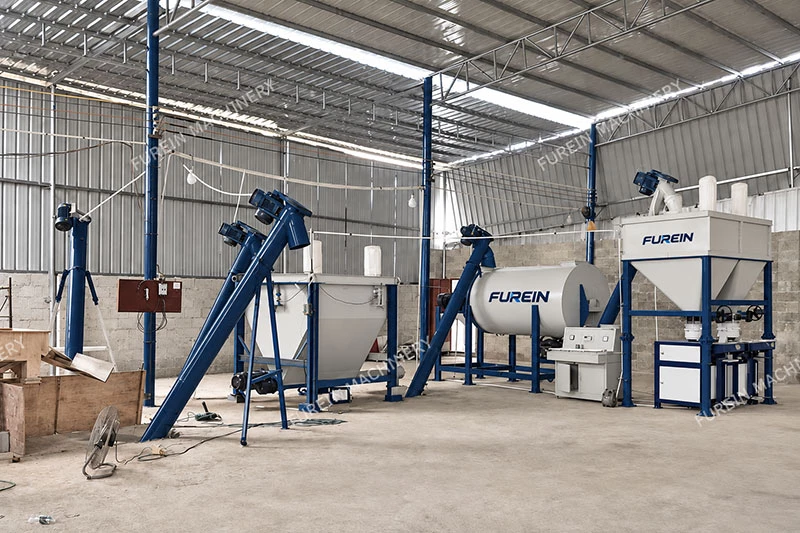
FUREIN supplies 1–10 T/H tile adhesive making machines for startups, small mortar factories and customers who need a compact and flexible production solution.
The layout of the small tile adhesive production line can be adjusted according to the available workshop height and floor space. Depending on the project, the weighing system can be installed below the mixer, in front of the mixer, or integrated into the feeding section.
The packing system can also be selected according to the customer’s bag type and required output. Open-mouth bags, valve bags and small-dose packing can all be supported with suitable packing equipment.
The goal is simple: use the space you already have, choose only the equipment you really need, and build a practical tile adhesive production system without unnecessary investment.
Công suất khoảng 10t/h
Two Capacity Options for Standard Tile Adhesive Making Machine
Choose the output that matches your current market and future production plan.
How to Choose the Right Tile Adhesive Making Machine?
The right small tile adhesive production line should be selected according to your raw materials, factory space, required capacity, bag type and preferred level of automation. For small projects, the most important point is not to use the most equipment, but to make the whole process simple, practical and easy to operate.
Choose the Feeding Method
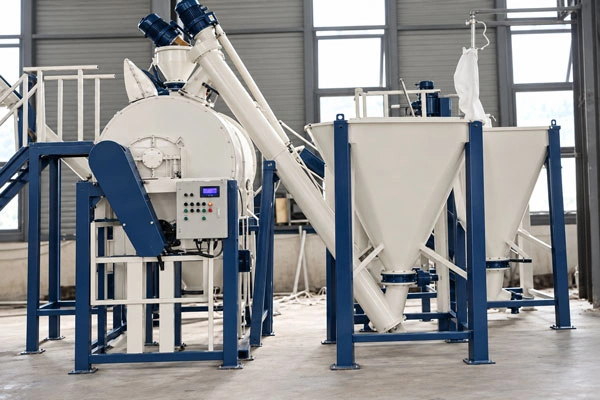
Different raw materials may require different feeding methods. Powder materials can be transferred by screw conveyor, while sand or bulk materials can also be fed by bucket elevator or hopper according to the plant layout.
Choose the Weighing Position
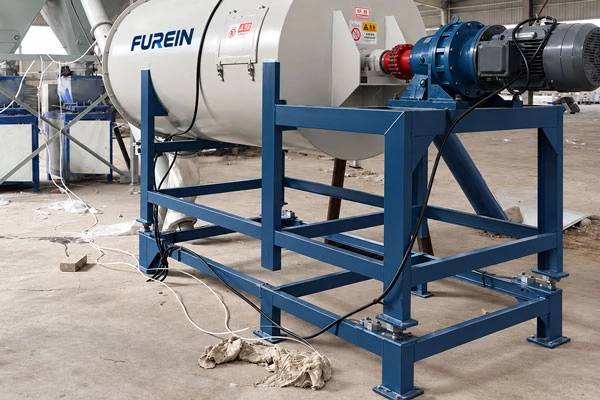
The weighing system does not have to be installed in only one position. Depending on the workshop height and equipment arrangement, the weighing hopper can be placed below the mixer, in front of the mixer, or above the mixer together with the feeding system.
Choose the Mixer
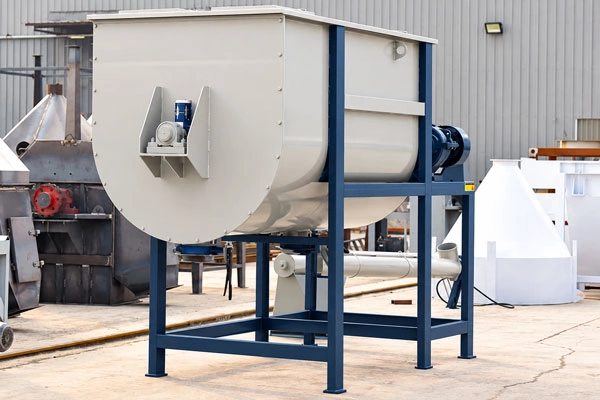
Small-capacity projects can use a ribbon mixer for a simple and economical configuration. For higher output or faster mixing, a double-shaft paddle mixer can be selected.
Choose the Packing Method
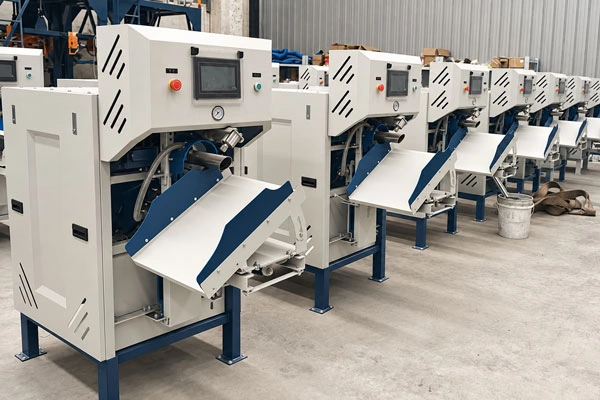
The packing machine should match the bag type, powder characteristics and required packing speed. Túi van, open-mouth bags and smaller packing sizes can all be supported with different packing equipment.
Packing Options for Small Tile Adhesive Production Lines
Different customers use different bags and packing sizes. FUREIN can match the tile adhesive packing machine to your bag type, powder characteristics and required output.
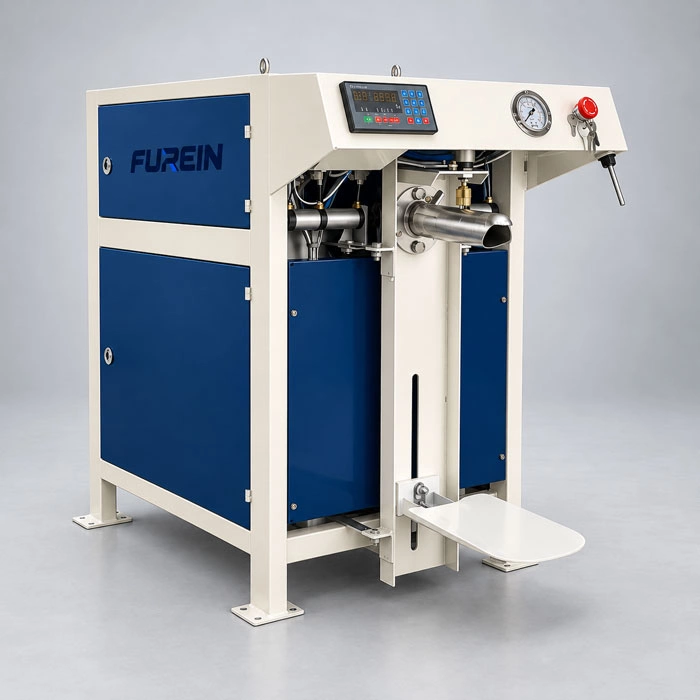
Máy đóng gói túi van
Commonly used for tile adhesive and other dry mortar products. Valve bags are easy to fill and do not require separate sewing after filling.
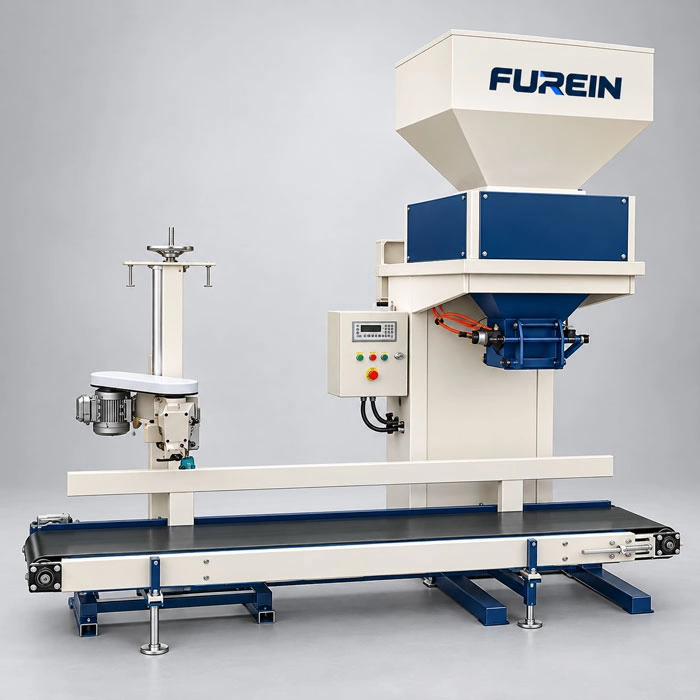
Open-Mouth Bag Packing Machine
Suitable for open-mouth bags and customers who need flexible bag sizes. The bag is placed manually and can be sealed by sewing or heat sealing depending on the bag material.
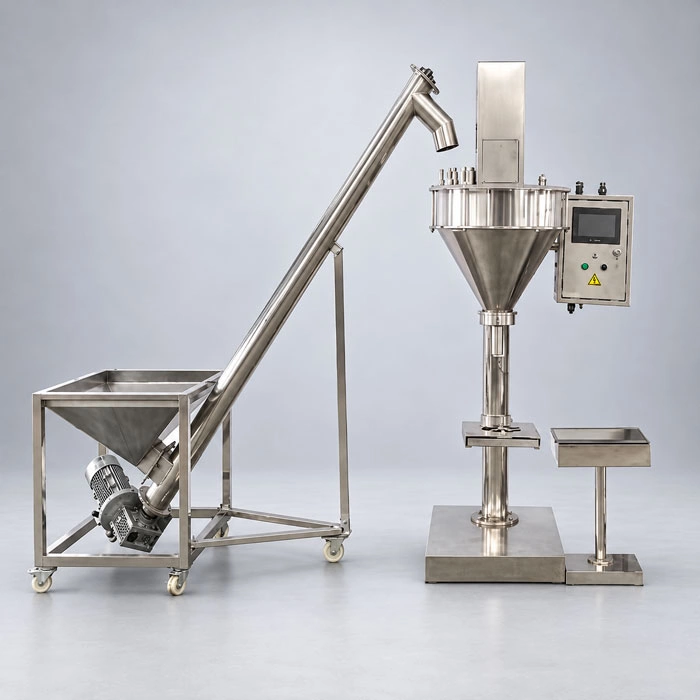
Small-Dose Packing Machine
Suitable for smaller bags or products that need lower packing weights. The configuration can be adjusted according to the required bag size and weighing range.
Small Footprint & Easy Installation
One of the main advantages of a small tile adhesive making machine is that it can be installed in a relatively compact workshop.
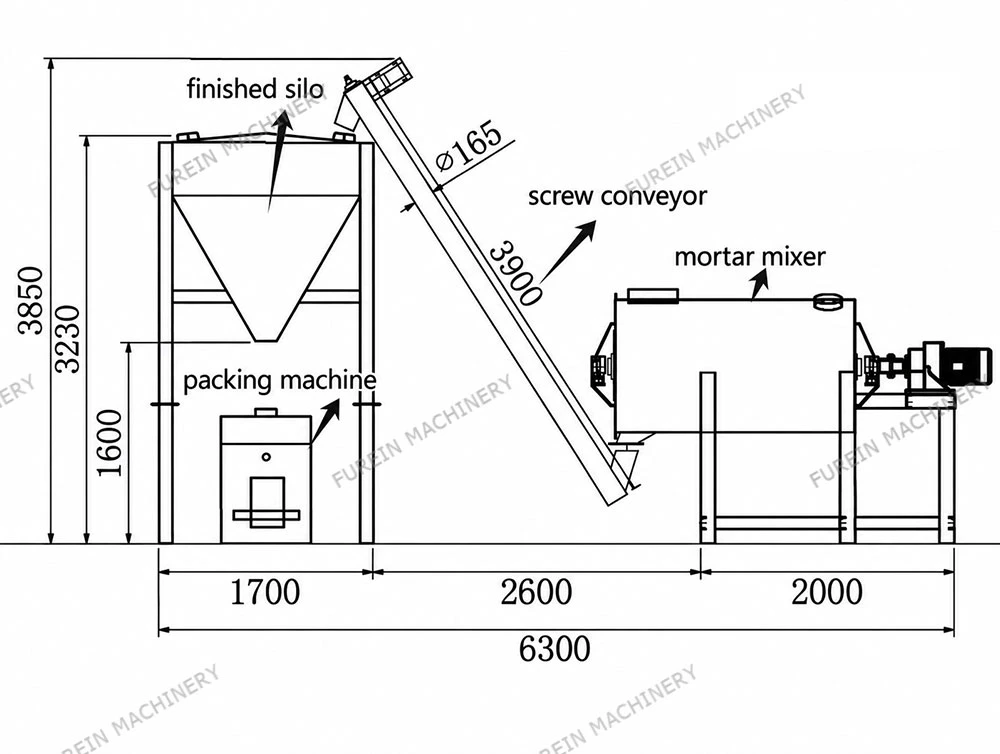
The equipment layout can be adjusted according to the available floor space and building height. For customers with an existing workshop, we can prepare a layout drawing based on the actual dimensions before production starts.
Compared with a large automatic mortar plant, a compact tile adhesive line requires less steel structure, fewer silos and a simpler installation process. This can reduce both installation time and initial investment.
Do You Need a Sand Dryer for a Small Tile Adhesive Production Line?
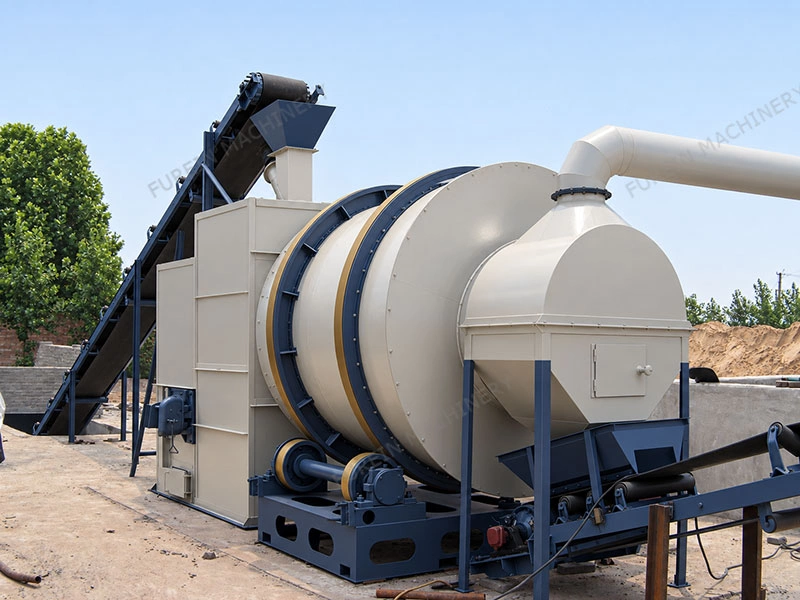
If you purchase dry graded sand, a sand dryer is normally not required.
If the sand moisture is higher than about 1%, drying may be recommended before the sand enters the tile adhesive production process. Excess moisture can affect weighing accuracy, material flow and final product stability.
For a small tile adhesive production line, the commonly selected sand dryer capacity is around 3 T/H or 5 TH, depending on the sand moisture and required production output.
The dryer capacity should be selected according to the wet sand moisture rather than only matching the mixer capacity.
Real Layout Examples for Small Tile Adhesive Making Machines
Small tile adhesive projects often look different because customers have different workshops, raw materials and packaging methods. These project examples show how the equipment can be adjusted to different production conditions.
Many customers already have an existing workshop, limited building height or a preferred feeding method. Instead of forcing every project into the same standard layout, FUREIN adjusts the small tile adhesive machine design according to the actual site.
Based on previous projects, we have added wear-resistant liners under mixers, installed batching hoppers above mixers, changed weighing positions, adjusted feeding directions and modified packing layouts to suit different factory conditions.
3–5 T/H Tile Adhesive Line with Bottom Weighing System
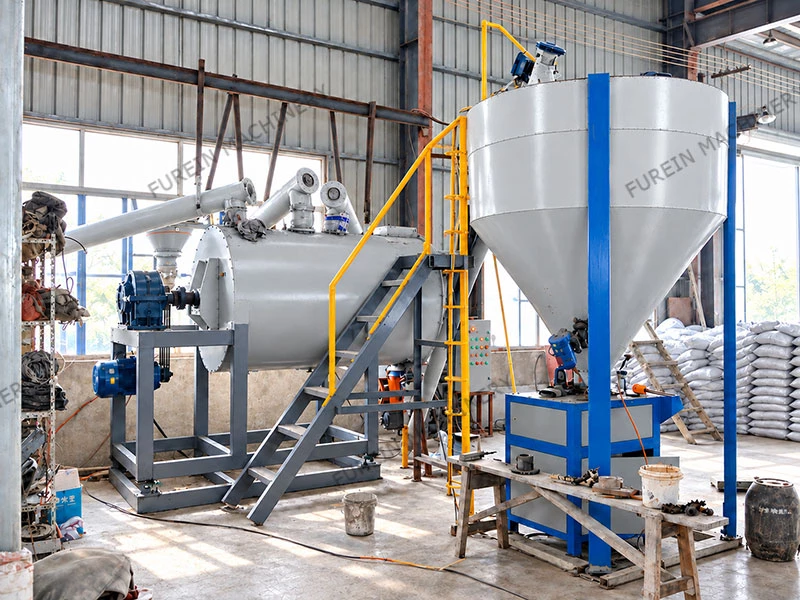
Tính năng: Automatic Batch Weighing Under the Mixer
This 3–5 T/H small tile adhesive production line uses an outdoor cement silo and screw conveyor to feed cement directly into an O-type ribbon mixer. A weighing system is installed below the mixer to automatically weigh each batch. The required recipe can be preset in the control cabinet, helping improve batch consistency while keeping the overall layout compact.
5–6 T/H Tile Adhesive Line with Three Feeding Systems
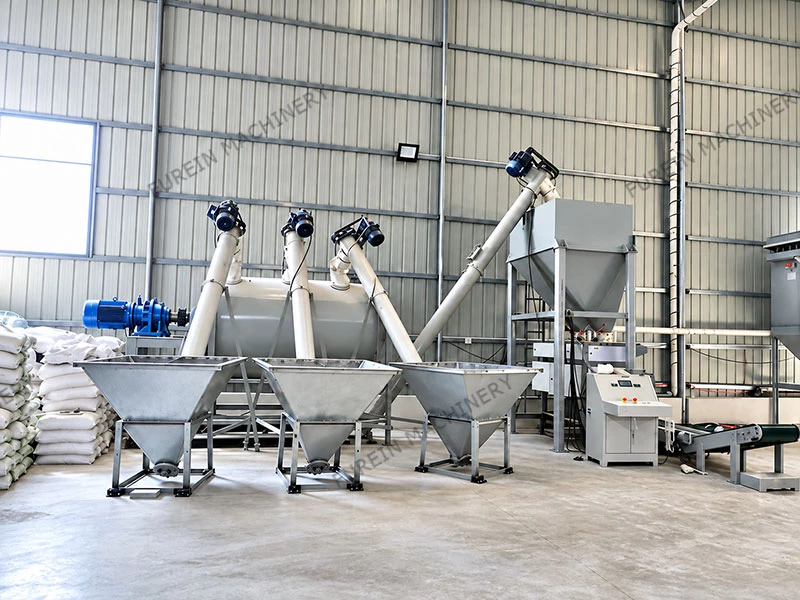
Tính năng: Three Feeding Lines for Main Raw Materials
This 5–6 T/H tile adhesive making machine uses three separate feeding systems to transfer the main raw materials into the mixer. After mixing, the finished material is discharged from the bottom of the mixer and transferred by a second screw conveyor to the finished product hopper for packing. This layout is suitable for customers who need to handle several main raw materials in a simple and organized way.
6–8 T/H Tile Adhesive Line with Buffer Hopper
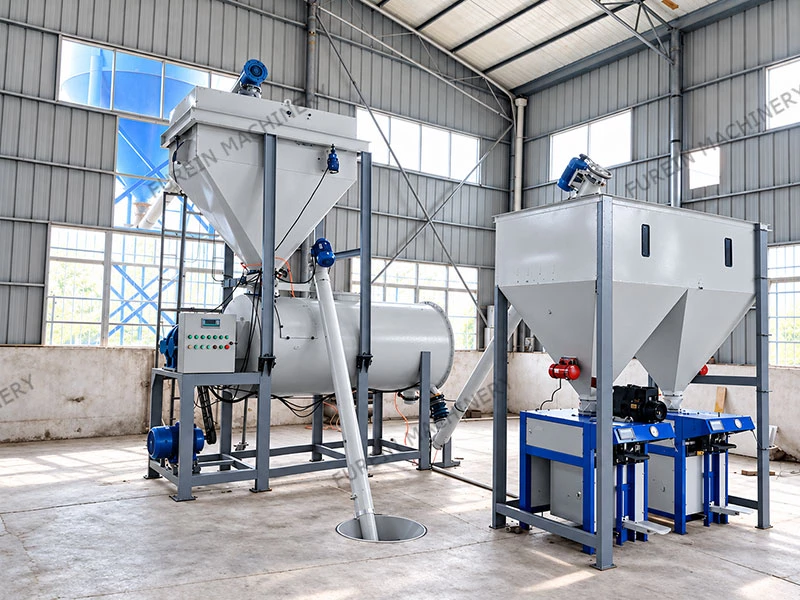
Tính năng: Buffer Storage Above the Mixer for Faster Feeding
This 6–8 T/H small tile adhesive production line is designed to improve feeding speed. A buffer hopper is installed above the mixer to temporarily store cement and other main materials. Smaller materials can be lifted from ground level by screw conveyor and fed into the system. Two valve bag packing machines are used to improve packing efficiency and better match the mixer output.
Twin-Mixer Tile Adhesive Production Line
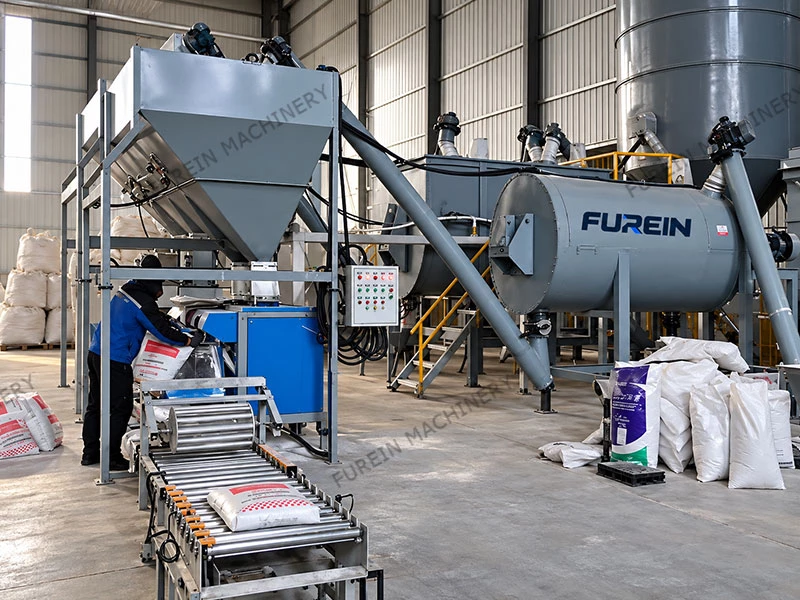
Tính năng: O-Type and U-Type Ribbon Mixers in One Production Site
This tile adhesive production site uses two mixers: an O-type ribbon mixer and a U-type ribbon mixer. The U-type mixer provides a more stable structure for certain raw material combinations and can be selected when the production formula contains more material types. The complete line is equipped with four air packing machines to handle higher packing demand and support continuous production.
Fully Automated Small Tile Adhesive Production Line
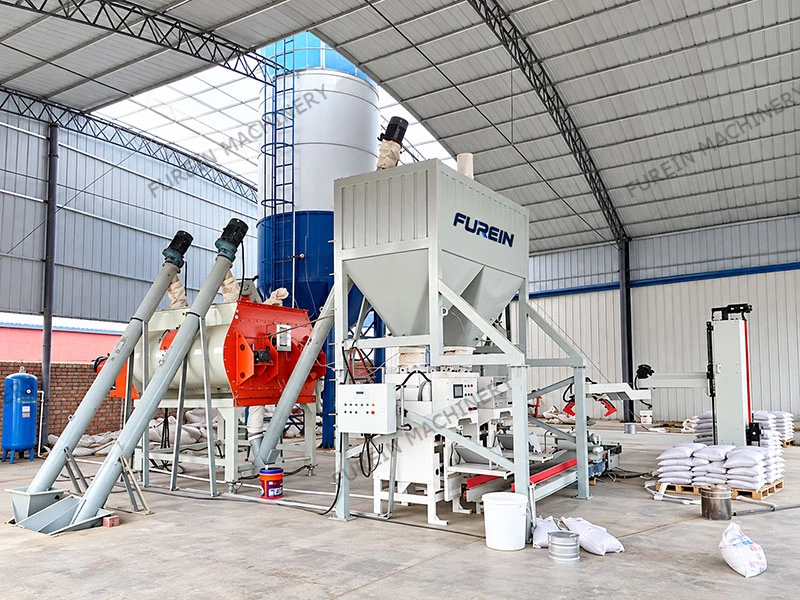
Tính năng: Full Automation from Feeding to Palletizing
This compact small tile adhesive production line uses ground-level feeding and two material feeding lines connected to a double-shaft mixer. After mixing, the finished material is transferred by screw conveyor to a double-outlet finished product hopper and packed by two air packing machines. The packed bags are then conveyed by belt conveyor to the palletizing area and stacked automatically by a column palletizer. Although the plant is compact, it achieves a complete automated process from feeding and mixing to packing and palletizing.
2–3 T/H Standard Tile Adhesive Production Line
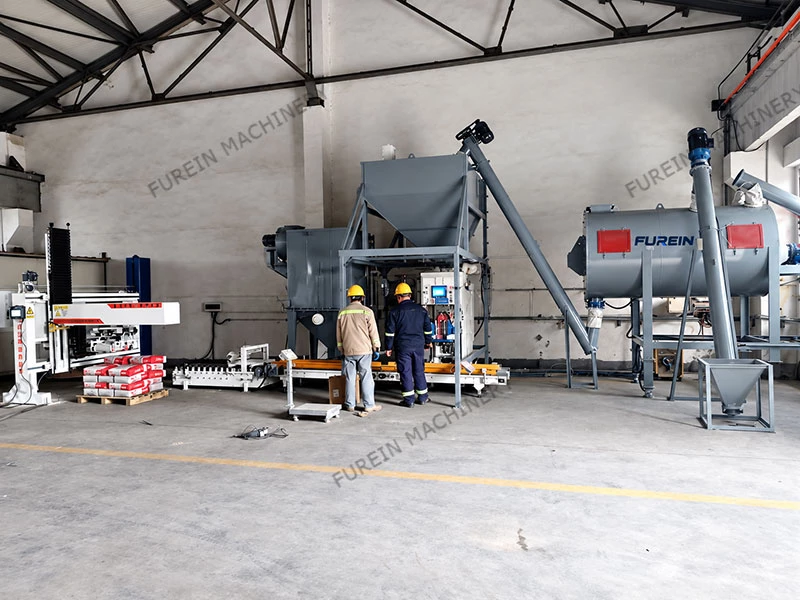
Tính năng: Standard Compact Layout with Dust Collection and Palletizing
This 2–3 T/H small tile adhesive making machine uses ground-level feeding, with raw materials transferred by screw conveyor into the mixer. After mixing, the finished material is packed by one air packing machine. The packed bags are then conveyed through a belt conveyor and bag shaping unit to the palletizing area, where a Cartesian palletizer stacks them automatically. A pulse dust collector is also included to improve the working environment and reduce dust during production.
Máy làm keo dán gạch cải tiến
- Máy sản xuất keo dán gạch cải tiến công suất 10-15t/h.
- Máy trộn keo dán gạch là máy trộn trục đôi.
- Sản lượng có thể lên tới 12t/h, thích hợp cho sản xuất khối lượng nhỏ. Đầu tư thấp và dấu chân nhỏ.
- Khi một bộ máy dán gạch cỡ nhỏ được lắp đặt, nói chung, chiều cao của toàn bộ máy nhỏ hơn 3,5m, và dấu chân ít hơn 2 mét vuông.
- Nó đã sử dụng một máy trộn keo dán gạch ruy băng, và thời gian trộn hàng loạt là khoảng 15 phút mỗi đợt.


Máy làm keo dán gạch với máy sấy cát
- Công suất của máy trộn keo dán gạch hai trục quyết định đầu ra của máy làm keo dán gạch.
- Đôi khi độ ẩm của nguyên liệu thô cao hơn 5%, thường xuyên, bộ máy sấy cát được cấu hình để làm khô nhanh độ ẩm của cát.
- Sau khi sấy khô, Cát khô nhanh chóng được đưa vào máy sản xuất keo dán gạch để xử lý tiếp thông qua băng tải.
- Máy sấy cát là đối tác tốt nhất của máy làm keo dán gạch.


Đúng. A small tile adhesive making machine has a relatively simple structure and is easy to operate. FUREIN provides installation manuals, video guidance and installation instructions. If you still need help, our engineers can also travel to your country for on-site installation support.
A small tile adhesive production line normally needs about 2–3 workers. They mainly handle raw material feeding and bagging, including manually placing bags onto the packing machine.
The packing machine should match your bag type.
For valve bags, use a valve bag packing machine.
For open-mouth bags, use an open-mouth packing machine.
These machines normally handle bags from about 10–50 kg.
For smaller bags of around 1–10 kg, a small-dose packing machine is recommended.
It depends on your production needs. For a 1–8 T/H tile adhesive production line, an automatic weighing system can be added if large quantities of raw materials need to be weighed automatically. For additives used in small quantities, usually only tens or hundreds of kilograms for the whole production process, manual feeding is often more economical.
For a small tile adhesive production line, a ribbon mixer is usually sufficient.
A double-shaft mixer mixes faster, but the mixer speed must match the packing and storage capacity. A faster mixer alone will not increase the output of the whole production line.
For higher capacity, a double-shaft mixer can be used, but the storage and packing systems should also be upgraded.
Đúng. The weighing system can be installed before the conveying system or below the tile adhesive mixer, depending on the feeding method and factory layout.
A small tile adhesive production line normally needs about 50 m² of floor space, with a workshop height of around 7 mét. These dimensions are not fixed. FUREIN can design the layout according to your existing factory size and height.
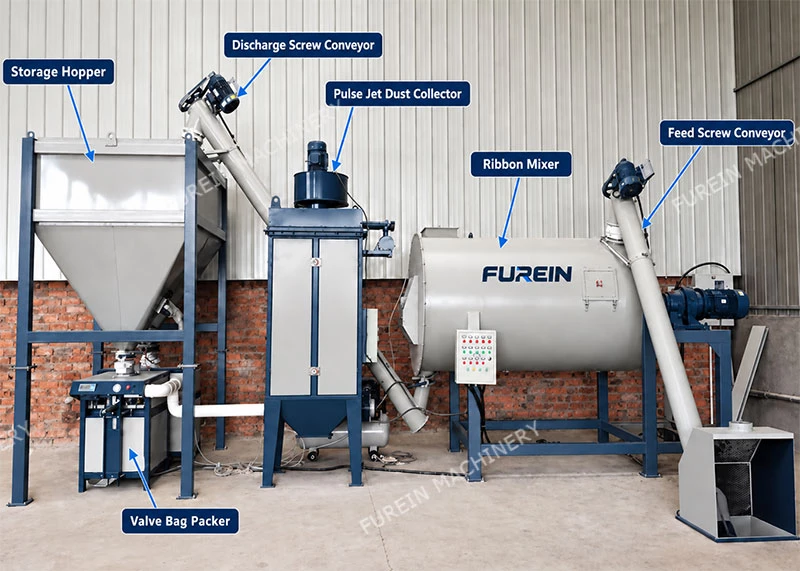
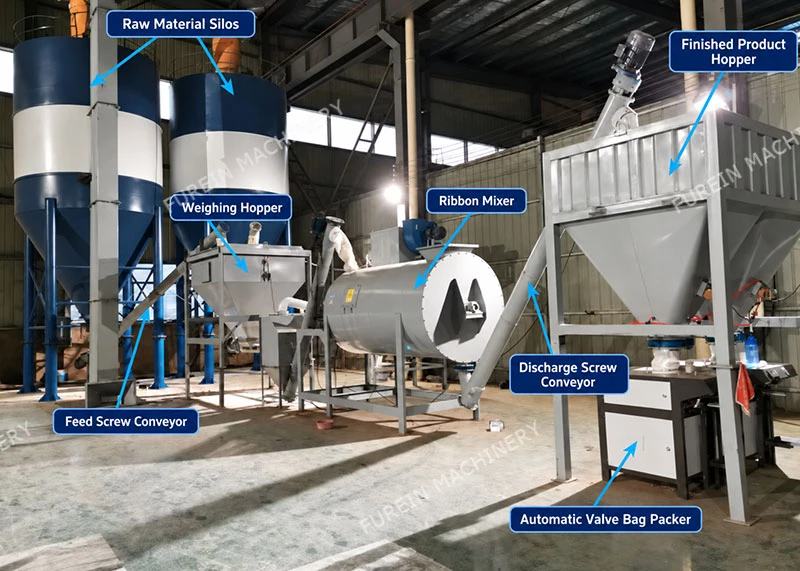
A small tile adhesive production line normally includes:
- Hệ thống cho ăn
- Hệ thống trộn
- Discharge system
- Hệ thống lưu trữ
- Hệ thống đóng gói
Optional equipment can include an automatic weighing system, dust collector and air compressor.
A small tile adhesive making machine usually costs about USD 3,000–8,000. The final price depends on the capacity, mixer type, hệ thống cho ăn, weighing system and packing machine.
Bigger capacity is not always better, and a more expensive machine is not always the right choice.
You should choose the tile adhesive making machine according to your current sales volume, expected demand and future production plan.
The capacity depends on the mixer size and the overall small tile adhesive production line configuration. Common options are: 1–2 T/H, 3–5 T/H, 5–8 T/H, and 8–10 T/H.
FUREIN can also provide tile adhesive production lines with capacities below 30 TH.
A small tile adhesive making machine is a compact and flexible production line for small businesses or startups. Its typical capacity is 1–10 T/H, and it requires relatively little factory space.
Máy làm keo dán gạch: Hướng dẫn Câu hỏi thường gặp Cơ bản
Linh kiện của máy dán keo dán gạch tự động?
- Silo xi măng bắt vít có thể tháo rời, thường phù hợp với thang máy xô ngoài trời.
- Silo xi măng thường được sử dụng cùng với trạm trộn bê tông và trạm vữa khô, nó có thể tháo rời, chúng tôi gọi nó là silo xi măng bắt vít.
- Chủ yếu được sử dụng để lưu trữ vật liệu rời như xi măng, tro bay, cát, vân vân.
- Đáy silo xi măng bắt vít là khung thép hình trụ, và chiều cao xả của silo xi măng có thể được tùy chỉnh theo tình hình thực tế của khách hàng.

Máy làm keo dán gạch
Hệ thống trộn được thiết kế để trộn kỹ các nguyên liệu thô đã được đo. Nó thường bao gồm một máy trộn, chẳng hạn như máy trộn ruy băng xoắn ốc hoặc máy trộn cánh khuấy hai trục, đảm bảo trộn đồng đều một cách nhanh chóng.
Máy trộn keo dán gạch mái chèo hai trục, thường có một phễu trộn sẵn ở trên cùng, và phễu sản xuất cuối cùng nằm bên dưới máy trộn.
Máy dán gạch không trọng lực chủ yếu dùng làm vữa chống nứt, vữa cách nhiệt, vữa liên kết, vữa bề mặt, vữa sàn và các vật liệu bột khác có yêu cầu trộn đồng đều cao, chẳng hạn như vữa khô, vữa liên kết, bột trét, keo dán gạch, và như thế.

Hệ thống đóng gói
Bạn có thể chọn một máy đóng gói van tự động, máy đóng gói cổng mở tự động, hoặc với số lượng lớn tùy theo sự thuận tiện của bạn.
• Hình bên phải là hình ảnh máy đóng van, có đặc tính tốc độ đóng gói nhanh và độ chính xác cao của cân.
• Nếu túi của bạn là túi đóng gói có van, sau đó chọn máy đóng gói van.
• Nếu túi của bạn là túi mở, sau đó chọn máy đóng gói cổng mở.

Hệ thống điều khiển
Có 2 hệ thống điều khiển để bạn lựa chọn, hệ thống điều khiển điện và tủ điều khiển PLC.
PLC là viết tắt của Bộ điều khiển logic khả trình.
Giao diện hệ thống điều khiển PLC đơn giản, dễ hiểu, dễ dàng hoạt động, tự động hóa cao, tiết kiệm lao động và nâng cao hiệu quả sản xuất.

Hệ thống thu gom bụi
Bạn có thể chọn giữa máy hút bụi dạng xung và máy hút bụi tiết kiệm.
Bộ thu bụi xung hiệu quả cao có thể giúp bạn thu gom bụi tốt hơn và thanh lọc môi trường.
Bộ lọc túi cho máy đóng gói tiết kiệm và có thể giúp bạn thu gom bụi với chi phí thấp hơn.

Nguyên lý hoạt động của máy dán keo dán gạch
Biểu đồ quy trình chính xác có thể giúp bạn thấy được lợi nhuận và cách bố trí tốt hơn của máy sản xuất keo dán gạch.
Nguyên tắc làm việc: Như thể hiện trong hình dưới đây, bên trái là nhà máy sấy cát, và bên phải là máy làm keo dán gạch tự động.
Quy trình làm việc của máy làm keo dán gạch như sau: Đầu tiên, để thêm vật liệu vào thang máy xô ngoài trời, vật liệu sẽ được chuyển đến silo xi măng bằng xô thang máy, Đáy silo xi măng có băng tải trục vít, vật liệu qua băng tải trục vít đến thang máy gầu trong nhà, sau đó nguyên liệu sẽ đến phễu trộn sẵn chờ trộn, sau đó vật liệu được chuyển đến máy trộn vữa khô trục đôi để trộn, vật liệu giếng trộn sẽ vào kho thành phẩm, có một hệ thống đóng gói, máy đóng gói túi van tự động sẽ đóng gói thành phẩm vào túi.
Thông số của máy làm keo dán gạch

Đầu ra của máy làm keo dán gạch đơn giản gồm 1-2T/H, 3-4TH, 5-6T/H và 6-8T/H.
Sản lượng của dây chuyền dán gạch tự động 10-15t/h, 15-25 th, 25-35 th, và mức tối đa có thể đạt tới 100 th.
Nếu bạn muốn biết danh sách cụ thể về máy làm keo dán gạch tùy chỉnh, hoặc giải pháp tùy chỉnh, Xin cứ thoải mái liên lạc với chúng tôi.
Công suất máy làm keo dán gạch là bao nhiêu?
Nói chung, công suất của máy làm keo dán gạch là 0,5t/h~100t/h.
Máy làm keo dán gạch nhỏ sử dụng máy trộn keo dán gạch ruy băng ba lớp và phạm vi quy trình của nó là:0.5t/h đến 8 th.
Nếu bạn muốn một máy làm keo dán gạch cỡ nhỏ có công suất lên tới 10t/h, vậy là được rồi. Hãy liên hệ với chúng tôi để có giải pháp ngay bây giờ.
Dây chuyền sản xuất keo dán gạch sử dụng máy trộn vữa nhẹ hai trục, công suất từ 8t/h đến 60t/h. Nếu bạn muốn đạt công suất 100t/h hoặc 150t/h, không có vấn đề gì, vui lòng liên hệ với chúng tôi để có giải pháp tùy chỉnh.
Một bộ máy làm keo dán gạch không chỉ có thể sản xuất keo dán gạch, mà còn sản xuất vữa khô khác, vì vậy chúng ta có thể gọi nó máy trộn vữa khô, nhà máy vữa trộn khô, dây chuyền sản xuất vữa trộn khô, nhà máy sản xuất keo dán gạch, máy sản xuất bột trét tường, nhà máy thạch cao trộn sẵn, vân vân.
Lợi ích của việc sử dụng máy dán keo dán gạch:
Tăng hiệu quả: Việc tự động hóa và tích hợp các bộ phận khác nhau trong máy giúp giảm lao động thủ công và tăng hiệu quả sản xuất.
Chất lượng phù hợp: Máy đảm bảo trộn đều và đo lường chính xác nguyên liệu thô, tạo ra keo dán gạch chất lượng cao.
Tùy chọn tùy chỉnh: Hệ thống điều khiển cho phép linh hoạt trong việc điều chỉnh công thức kết dính, đáp ứng các yêu cầu cụ thể của các dự án khác nhau.
Tiết kiệm chi phí: Bằng cách sản xuất keo dán gạch trong nhà, Công ty xây dựng có thể tiết kiệm chi phí so với mua keo dán sẵn.
Tóm lại là, Máy dán gạch là công cụ thiết yếu để sản xuất keo dán gạch chất lượng cao. Nó cho phép hiệu quả, nhất quán, sản xuất tùy chỉnh, cung cấp cho các dự án xây dựng các giải pháp liên kết đáng tin cậy và bền vững.


